
Dead Zones FAQ
What exactly are dead zones?
Dead zones are areas of a waterbody with low-oxygen (hypoxic) conditions unsuitable for most marine life. They occur toward the bottom of the water column and begin to form when excess nutrients, typically nitrogen and phosphorus from human activities such as agricultural practices and wastewater treatment enter the water and stimulate the growth of naturally occurring algae.
When large algal blooms die off, they sink to the bottom and are decomposed by bacteria. This decomposition process removes oxygen from surrounding waters. When algal blooms are large enough, that decomposition process results in a significant loss of oxygen from the bottom water, creating a dead zone.
How do dead zones impact the Chesapeake Bay?
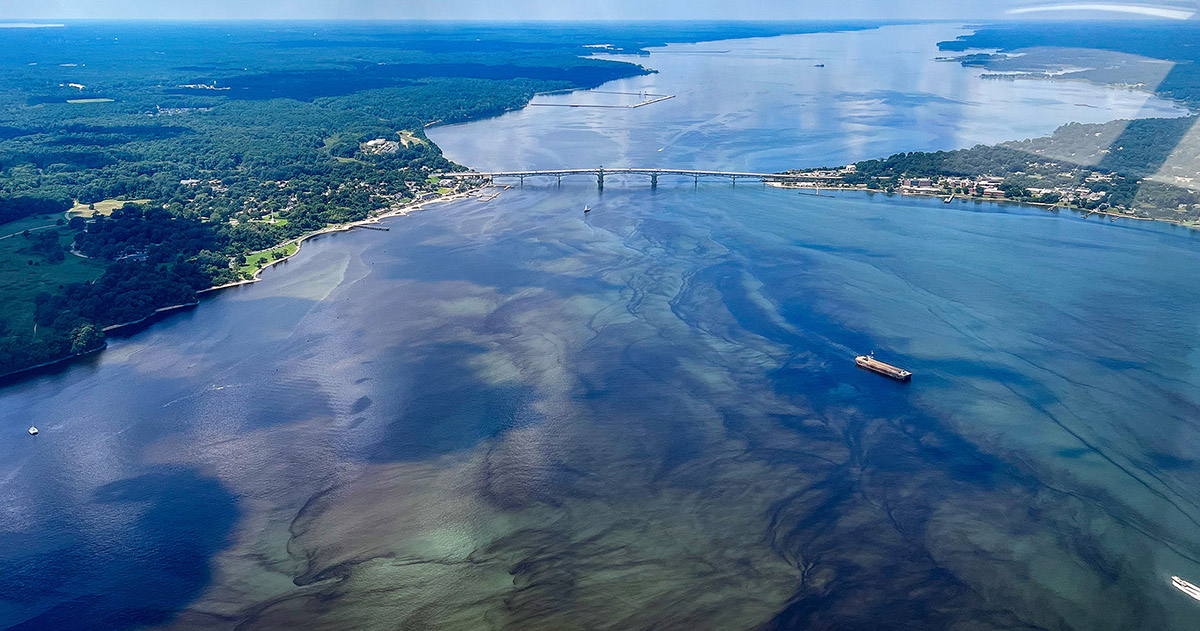
There can be significant variation in the timing and intensity of the Chesapeake Bay’s dead zone from year to year. Factors related to this variability include winds and precipitation from extreme weather events, atmospheric temperatures (heat waves) as well as changes in the loading of nutrients entering the Bay.
Because low-oxygen waters impact marine animals and ecosystems, scientists at William & Mary’s Batten School of Coastal & Marine Sciences & VIMS and FlowWest have developed the Chesapeake Bay Environmental Forecast System (CBEFS) to predict when and where hypoxic conditions in the Bay may form. CBEFS provides a 5-day forecast of dissolved oxygen throughout the Bay and shows how oxygen is changing over that time. The goal is to help fishers, community members and government leaders stay informed and implement practices and policies that have lasting, positive impacts on the Bay.
Is there a summary of annual severity of dead zones in the Chesapeake Bay?
Yes! Each year, the Batten School & VIMS and FlowWest release a report detailing the volume and duration of low-oxygen conditions in the Chesapeake Bay. The annual Dead Zone report card is created using the team’s real-time water quality model and summarizes dissolved oxygen concentrations throughout the Bay. You can access the report cards here.
How can we reduce the severity of dead zones?
The best way to reduce the intensity of dead zones in our waters is to reduce the input of nutrients into estuaries and the coastal ocean. Nutrient-reduction strategies are a key part of efforts to restore the health of the Chesapeake Bay and other estuaries, lakes, and coastal waters around the country.
An important strategy in reducing the size and duration of dead zones is establishment of a total daily maximum load (TMDL) for the nutrients (nitrogen and phosphorus) that encourage dead zone formation. These TMDLs encourage innovations in urban and agricultural land practices and wastewater and stormwater management and are crucial in addressing dead zones.
Researchers at the Batten School & VIMS collaborate with colleagues around the world to address the problem of marine dead zones, including efforts to:
- understand how dead zones form,
- decipher how dead zones affect marine organisms and communities,
- monitor and model dead-zone prevalence and duration,
- develop criteria to gauge the severity of dead zones, and
- provide guidance to policymakers and resource managers concerning the land-use and water-quality strategies needed to reduce dead-zone formation.
What’s a total maximum daily load?
A total maximum daily load (TMDL) is similar to the "recommended daily allowances" found on food labels. TMDLs indicate the maximum amount of a pollutant, like nitrogen or phosphorus, that can enter a water body without causing a water-quality indicator such as dissolved-oxygen levels to cross a defined threshold.
Water-quality thresholds can vary depending on a water body's "designated use." These include use by native marine life, commercial harvesting of fish and shellfish, and recreational uses such as swimming and boating. The thresholds also recognize seasonal variations in nutrient inputs and dissolved-oxygen levels, as well as differences in dissolved-oxygen levels in different Bay habitats.
Batten School & VIMS researchers work with partners in state and federal agencies on all three steps of the TMDL plan for nutrient pollution to meet Chesapeake Bay TMDL Goals set forth by the Environmental Protection Agency.
What impact will climate change have on dead zones?
Dead zones can develop more easily and expand more rapidly due to the effects of global change, including increases in air and water temperatures. The good news is that if we account for this when establishing watershed management practices such as TMDLs, our water quality improvements can offset the negative impacts of climate change.
Of course, we live on a dynamic planet, and in any given year the effects of climate change could act to increase or decrease the timing and intensity of dead zones in a given waterbody. A recent study led by Batten School & VIMS scientists has demonstrated surprising variability in the results of different modeling methodologies for predicting dead zone conditions in the Chesapeake Bay.
It is important that we continue developing research and modeling tools that help communities predict, prepare for, and respond to dead zones in our changing world.