
Atlantic Menhaden
An Overview of Atlantic Menhaden
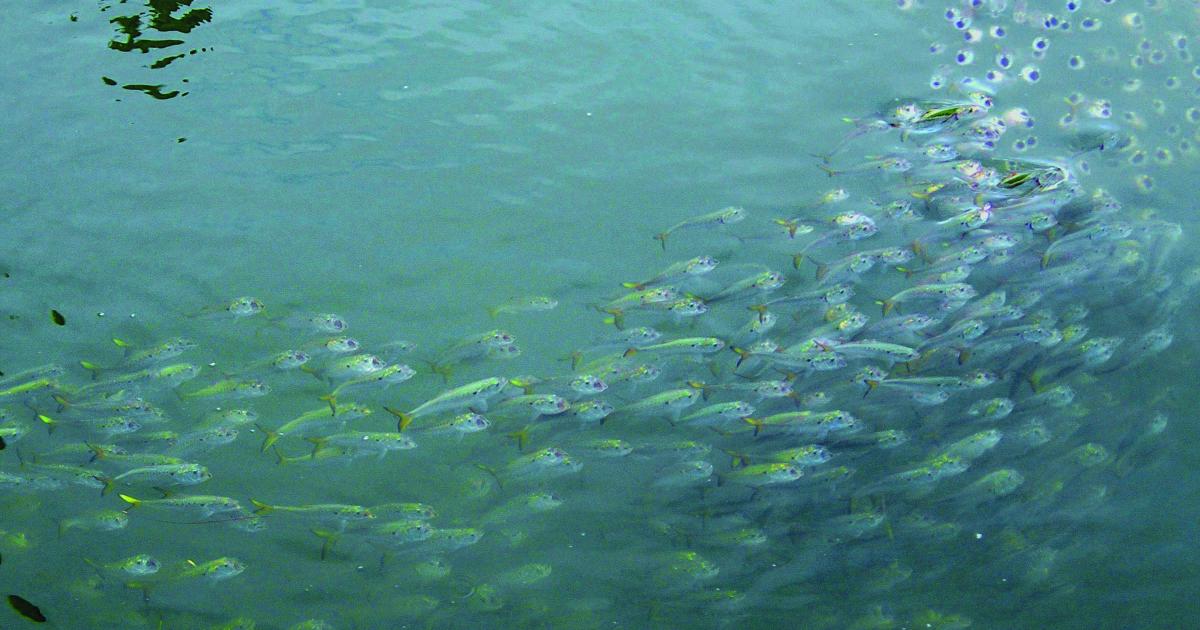
Atlantic menhaden (Brevoortia tyrannus) are small (maximum length = 15 inches) schooling fish related to herring, shad and sardines. The species inhabits near-shore waters along the Atlantic seaboard from Nova Scotia southward to central Florida, making them a valuable aspect of North American commercial and recreational fisheries as well as coastal ecotourism industries.
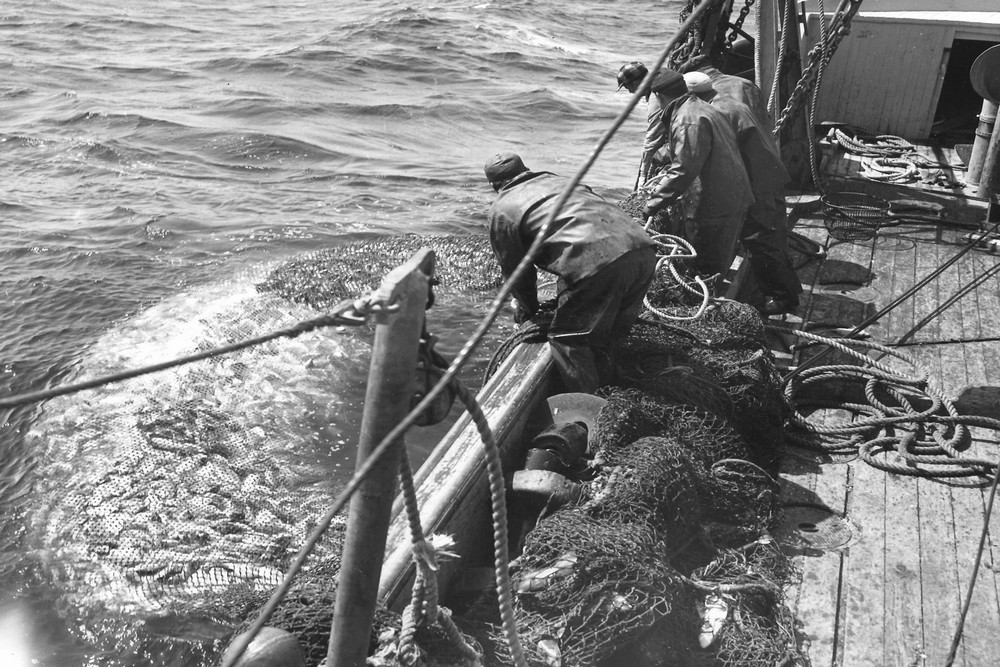
Managed by the Atlantic States Marine Fisheries Commission (ASMFC) through an interstate fishery management plan (FMP), Atlantic menhaden fisheries support both commercial reduction practices as well as bait harvests. Commercial and recreational fishers utilize menhaden as bait for target species, while Virginia’s reduction fishery converts them into fishmeal and fish oil.
Atlantic menhaden provide important ecological services as well. As filter feeders, menhaden filter organic matter from our waters. They are also a source of food for a wide range of species including striped bass, bluefish, weakfish, sea birds and marine mammals.
Spawning primarily occurs in the cooler months from southern New England through the Carolinas in offshore waters. Eggs hatch at sea before ocean currents bring menhaden larvae into coastal habitats, where they metamorphose into juvenile fish. Juveniles spend most of their first year in protected estuarine habitats, migrating to the ocean in late fall. Adult and juvenile menhaden form large schools near the surface of the water, primarily in estuaries and nearshore ocean waters.
A Brief History of the Menhaden Fishery
- 1942: The Atlantic States Marine Fisheries Commission's (ASMFC) was formed by the 15 Atlantic coast states in 1942 to coordinate the conservation and management of the states' shared nearshore fishery resources for sustainable use.
- 1956: The year that peak landings (catch) of Atlantic menhaden occurred, with 712,000 metric tons (mt) being caught. At the time, over 20 menhaden reduction factories were in operation along the U.S. Atlantic coastline.
- 1981: ASMFC established the first interstate fisheries management plan for Atlantic menhaden, establishing a framework for fisheries to operate through.
- 1993: The Atlantic Coastal Fisheries Cooperative Management Act was established, providing ASMFC with additional authorities related to the development, implementation, and enforcement of effective interstate conservation and management plans.
- 2006: Menhaden reduction industry contracts into one Atlantic reduction company processing menhaden in Reedville, Virginia (Omega Protein).
- 2020: ASMFC Atlantic Menhaden Board moves toward an ecosystem approach to fisheries management (EAFM) by approving the use of ecological reference points (ERPs) for the management of menhaden and to account for the species' role as a forage fish.
- 2023: The Batten School & VIMS respond to Virginia Senate Bill 1388 with a Atlantic Menhaden Research Planning study, developed in collaboration with key stakeholders. Though considered in subsequent sessions of the Virginia General Assembly, this legislation has not been passed.
- 2025: Data through 2023 shows that coastwide Atlantic menhaden stock is not overfished and not experiencing overfishing. However, based on the results of model projections, the ASFMC Board voted to reduce the coastwide total allowable catch (TAC) by 20% for 2026 and initiated the process to explore potential changes to the TAC for the Chesapeake Bay. It is expected that adjustments to the TAC for 2027 and 2028 will be determined in fall 2026.
- 2026: During the 2026 session of the Virginia General Assembly, lawmakers again considered multiple bills related to the Chesapeake Bay menhaden fishery. Proposals included measures to pause industrial menhaden fishing in the Bay, require more scientific study, establish seasonal or monthly harvest quotas and expand onboard observer programs to improve data collection. While none of the measures passed during the regular session, Virginia continues working to finalize its next biennial budget.
Federally, the FY2026 Commerce, Justice, Science (CJS) appropriations bill included $2.5 million for NOAA to support a new, Bay-specific study of Atlantic menhaden. The funding directs NOAA’s fisheries science programs to improve data on menhaden abundance, distribution and ecological role within the Bay. Specific details for carrying out this research have not yet been established.
Menhaden in the Chesapeake Bay
Menhaden are common in the Chesapeake Bay from spring through summer, swimming in large schools near the water's surface. During the fall and early winter most menhaden migrate out of the Bay and away from the coast, returning again in the spring. Summer die-offs of Atlantic menhaden occur in the Chesapeake Bay, mostly associated with episodes of low dissolved oxygen (i.e., dead zones) in Bay waters.
Atlantic menhaden provide important ecosystem services in the Chesapeake Bay and support economically important fishery practices. It is important that we understand the status of menhaden in the Bay, however we do not currently have the necessary data to determine stock size or abundance. Due to their complex and migratory lifecycle, it is difficult to conduct ecosystem fisheries studies on menhaden within estuaries.
Concerns about the status of the Atlantic menhaden stock have led the Atlantic States Marine Fisheries Commission (ASMFC) to identify broad research questions that must be answered in order to evaluate the status of Atlantic menhaden in the Chesapeake Bay.
In response to the 2023 Virginia Senate Bill 1388, Batten School & VIMS scientists and advisors worked closely with the Virginia Marine Resources Commission, ASMFC Atlantic Menhaden Technical Committee, representatives of menhaden fisheries and other stakeholders to develop and provide research recommendations for understanding Atlantic menhaden and its fisheries in the Bay.
Our research recommendations are based on the consensus of those stakeholder groups and explore three research priorities: ecology, fishery impacts and economic importance. The Batten School & VIMS remains at the ready to advance this research on Atlantic menhaden and their status in the Chesapeake Bay should resources become available to support that work.
Our Contributions to Menhaden Research
Historically, researchers at the Batten School & VIMS were involved in several projects designed to provide valuable data required to sustainably manage menhaden stocks in the Chesapeake Bay, including:
- Assessing technology associated with determining the abundance of menhaden in Chesapeake Bay
- An assessment of the social and economic importance of menhaden in the Bay
- Quantifying the role of menhaden in water-column filtration and as major prey in Chesapeake Bay
- Better understanding recruitment dynamics by determining juvenile menhaden abundance
- The reproductive biology and fecundity of female menhaden
Scientists from the Batten School & VIMS, along with partners from the University of Maryland Center for Environmental Science (UMCES) and the National Oceanic and Atmospheric Administration (NOAA), have received funding to conduct a literature review of existing science, industry data, and agency reports on Atlantic menhaden and similar pelagic fishes with the goal of establishing a roadmap for a scientifically derived menhaden catch limit in Chesapeake Bay. This work is complementary to, but does not replace the need for more extensive research on the ecology, fishery impacts and economic importance of the Atlantic menhaden population in Virginia waters and the Bay.
Funding for this research is provided through the Science Center for Marine Fisheries, which brings together academic expertise to direct research with industry partners capable of supporting those scientific endeavors. To further this work, scientists from Batten School & VIMS, UMCES and NOAA will seek access to confidential catch data that has not been shared previously by the commercial menhaden industry.
In addition, the Batten School & VIMS will help lead another SCEMFIS-supported study testing whether modern tagging technology can help scientists better estimate Atlantic menhaden abundance in the Chesapeake Bay, an important step toward setting a science-based harvest limit. The project will evaluate the use of passive integrated transponder (PIT) tags to track fish survival, movement and capture rates, addressing long-standing gaps in data that current methods cannot fully resolve.
The two SCEMFIS projects are supported by approximately $50,000 each and are designed to lay the groundwork for a more comprehensive study, should funding become available.
For media inquiries related to Atlantic Menhaden, please submit a media request.
Page last updated May 2026