

Shallow Water Habitats
Human Effects - Example: Dissolved Oxygen as an Indicator
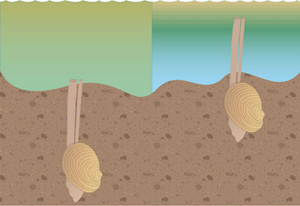 Dissolved oxygen is used as an indicator of water quality and eutrophication status
of estuaries. For example, in the Chesapeake Bay and its tributaries
EPA has established various dissolved oxygen criteria depending upon
the “designated use” of the various habitats in the system.
“Designated use” refers to use by migratory and resident fish,
shellfish, and other fauna.
Dissolved oxygen is used as an indicator of water quality and eutrophication status
of estuaries. For example, in the Chesapeake Bay and its tributaries
EPA has established various dissolved oxygen criteria depending upon
the “designated use” of the various habitats in the system.
“Designated use” refers to use by migratory and resident fish,
shellfish, and other fauna.
When dissolved oxygen concentrations are less than 2 mg/l the water body is described as hypoxic, and when there is no measurable oxygen, the system is anoxic. Managers are concerned when hypoxia develops not only because of the deleterious effects of low oxygen of fauna, but also because hypoxic water tends to be a source of nutrients to the water column, thereby supporting increased eutrophication.
The development of hypoxia or anoxia depends upon interactions between biological and physical factors. For example, when organic matter inputs are high, hypoxia is most likely to develop when the water column is stratified. Stratification of the water column is determined by a variety of factors such as fresh-water discharge, wind-driven mixing, temperature and lunar tidal cycle. Stratification restricts vertical mixing of oxygen between surface and deeper water.
Shallow waters are much less likely to stratify compared to deep waters. First, they tend to be well-mixed by winds and tides. In those systems where light reaches to the sediment surface the dissolved oxygen concentration will be determined by the balance between primary production and respiration (P/R). Autotrophs responsible for production in shallow water include phytoplankton, benthic microalgae and macroalgae. Bacteria, mainly in the sediments, are responsible for respiration of organic matter, a process that removes oxygen and releases nutrients to the water column.
Numerous factors influence the ratio of P/R, including diversity and community composition of the autotrophs, nutrient enrichment, turbidity and resuspension, residence time of the water body, the organic content of the sediment, and pollutants. P/R tends to decrease with increasing nutrient enrichment and eutrophication; systems with a daily P/R < 1 will tend toward hypoxia.
You can learn more about use of dissolved oxygen as an indicator of water quality by visiting: