

Shallow Water Habitats
Ecosystem Processes - Respiration
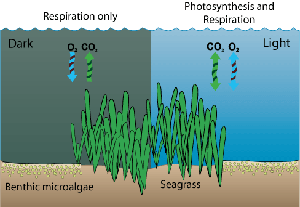 During respiration some of the organic matter produced during photosynthesis
is used to generate energy needed to support normal everyday functions,
either by the primary producers themselves, or by the consumers who use
the organic matter for food and energy.
During respiration some of the organic matter produced during photosynthesis
is used to generate energy needed to support normal everyday functions,
either by the primary producers themselves, or by the consumers who use
the organic matter for food and energy.
In plants, animals, and many bacteria, respiration requires oxygen and produces carbon dioxide. Other bacteria are able to respire using nitrate or sulfate. This ability to use other molecules in respiration is very important in estuarine and other coastal areas. During periods of hypoxia or anoxia, and in fine sediments, where free oxygen is almost always limiting, certain bacteria will continue to degrade organic matter and recycle nutrients despite the absence of oxygen.
When organic matter is plentiful, bacteria may remove sufficient oxygen from sediments or the water column to cause either hypoxia or anoxia. When sulfate is used in anaerobic respiration, sulfide, which tends to be toxic or inhibitory to plants, animals, and some bacterial processes, may accumulate. Bacteria and Archaea are better able than any other living organisms to use a wide variety of organic molecules as energy and carbon sources. Because of their metabolic diversity, they are able to occupy virtually all portions of the earth.
For further information about respiration in estuarine and coastal marine habitats, refer to the following:
Day, J. W., C. S. Hall, W. M. Kemp and A. Yánez-Arancibia. 1989.
Estuarine Ecology. John Wiley and Sons. Chapter 7 – Microbial ecology
and organic detritus in estuaries. (Note: the second edition of this
book is scheduled for release in March 2008)
Konhauser, K. 2007. Introduction to Geomicrobiology. Blackwell Publishing.
Munn, C. B. 2004. Marine Microbiology: Ecology and Applications. Garland Science/BIOS Scientific Publishers.
Valiela, I. 1995. Marine Ecological Processes (2nd Edition). Springer; Chapter 7 – Processing of consumed energy; Chapter 13 – The carbon cycle: production and transformations of organic matter.