

Shallow Water Habitats
Ecosystem Processes - Primary Production
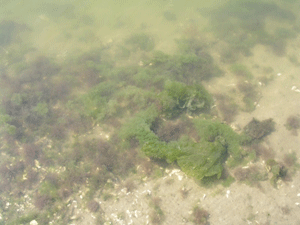 Gross primary production (GPP) is the
fixation of inorganic carbon into organic matter by primary producers
such as trees, plants, sea grass, benthic microalgae, some bacteria, macroalgae, and phytoplankton. It is a measure of the total rate of production of new biomass.
Gross primary production (GPP) is the
fixation of inorganic carbon into organic matter by primary producers
such as trees, plants, sea grass, benthic microalgae, some bacteria, macroalgae, and phytoplankton. It is a measure of the total rate of production of new biomass.
GPP occurs by photosynthesis, a process in which primary producers
harness the energy of the sun and convert carbon dioxide and water to
chemical energy (ATP), oxygen and carbohydrates or sugars. In order to
grow, primary producers also need nutrients, such as nitrogen and
phosphorus. GPP is important because it produces the organic matter
(food) needed to support animal life on land and in the ocean. In
addition, the oxygen produced by photosynthesis is used in the process
of respiration.
Net primary production (NPP) takes into account the costs of respiration for the primary producer – it is defined as the fixed carbon from photosynthesis that remains after respiration by the primary producer.
Photosynthesis only occurs in the light, while respiration occurs in
both the light and dark. The quality and quantity of light required to
support photosynthesis varies greatly among autotrophs and may
determine which primary producers dominate in a particular habitat.
For example, the submerged aquatic plant Zostera marina (eel grass) requires up to 10-times more light than do benthic microalgae.
Other variables that affect autotrophic dominance are nutrient enrichment, sediment type, and residence time. For example, if the residence time of a body of water is less than the time it takes for a phytoplankton cell to multiply, phytoplankton will tend to be washed out of the system, and attached autotrophs such a benthic microalgae or macroalgae might be favored. With increased nutrient enrichment and residence time there may be a shift of dominance from benthic autotrophs (sea grass and benthic microalgae) to pelagic autotrophs (phytoplankton). Since benthic autotrophs tend to buffer the water column from excess nutrient enrichment, the shift in dominance to pelagic autotrophs may result in reduced water quality.
For further information about photosynthesis in estuarine and coastal marine habitats, refer to the following:
Lalli, C. M. and T. M. Parsons. 1997. Biological Oceanography, An
Introduction (2nd Edition). The Open University. 314 pp. ; Chapter 3 –
Phytoplankton and primary production.
Valiela, I. 1995. Marine Ecological Processes (2nd Edition). Springer; Chapter 13 – The carbon cycle: production and transformations of organic matter