

Shallow Water Habitats
Shallow Water Communities - Microbes
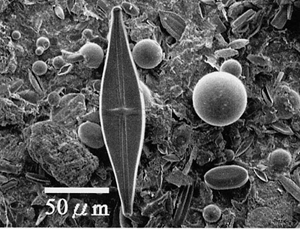 Although you would never know it from
casual observation, there is an unseen world of taxonomic diversity
living within the sediment! Viruses, bacteria, Archaea, algae, and
protists are all part of the microbial world of the benthos (from the
Greek for “bottom of the sea”).
Although you would never know it from
casual observation, there is an unseen world of taxonomic diversity
living within the sediment! Viruses, bacteria, Archaea, algae, and
protists are all part of the microbial world of the benthos (from the
Greek for “bottom of the sea”).
These organisms
vary considerably in complexity. Viruses are acellular entities that
are made up of molecules of RNA or DNA surrounded by protein coats.
Viruses are not alive in the traditional sense, but they are able to
reproduce by taking over the cellular machinery of other organisms.
Bacteria and Archaea are what scientists call prokaryotes. This means
that their DNA (genetic material) is not contained within a membrane
bound structure called a nucleus as in the cells of eukaryotes (see
below).
Bacteria and Archaea are very abundant in aquatic systems, with up to
10 billion per cubic cm in sediments and 1 million per cubic cm within
the water column. What makes prokaryotes unique is their metabolic
flexibility. Because of their ability to use a wide variety of energy,
carbon, and nutrient sources, they can occupy an extremely wide
diversity of habitats and account for the largest component of living
biomass on earth.
Prokaryotes make their livings in many different ways. Some are
photoautotrophs - they convert light energy to food via photosynthesis.
Others are chemoautotrophs, which produce the energy they need by
oxidizing other molecules such as hydrogen sulfide (produces smell of
rotten eggs) and ammonium. Others are heterotrophic, which means they
use various organic molecules to gain necessary energy and nutrients.
These forms may require oxygen, nitrate or sulfate for respiration.
In addition to substrates used as energy and carbon sources,
prokaryotes also require nutrients such as nitrogen and phosphorus to
build biomass.
Microbial eukaryotes such as
algae, fungi, and protozoans are organisms with a nucleus containing
genetic material, as well as other complex structures within their
cells (called organelles). Some of these organisms, in spite of being
only one cell, are quite complex.
Both heterotrophs and photoautotrophs are found among the microbial
eukaryotes. Others can switch back and forth depending on available
resources.
While the role of many microorganisms in aquatic systems is still being
researched, it is clear most of them are important components of benthic food webs or have important roles in key ecosystem processes. They provide food for other organisms such as meiofauna and macrofauna. They also play an important role in stabilizing sediment, cycling nutrients and organic matter.
For further information about microbial communities in estuarine and
coastal marine habitats refer to the following:
Day, J. W., C. S. Hall, W. M. Kemp and A. Yánez-Arancibia. 1989.
Estuarine Ecology. John Wiley and Sons. Chapter 7 – Microbial ecology
and organic detritus in estuaries. (Note: the second edition of this
book is scheduled for release in March 2008)
Konhauser, K. 2007. Introduction to Geomicrobiology. Blackwell
Publishing. Mann, K. H. 2000. Ecology of coastal waters, with
implications for management. Blackwell Publishing; Chapter 3 – Salt
marshes
Munn, C. B. 2004. Marine Microbiology: Ecology and Applications. Garland Science/BIOS Scientific Publishers.