

Shallow Water Habitats
Methods - Water Column Characteristics
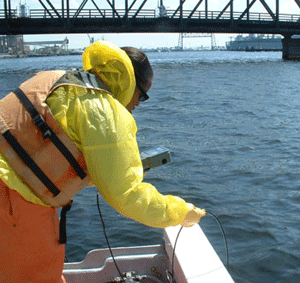 Basic water quality parameters and depth
of the water column should always be monitored to provide a record of
environmental conditions at the time of sampling and to provide
information used in assessing the condition of benthic assemblages and
understanding ecosystem processes. Water quality parameters should be
measured at the same time and location as any biological sampling.
While episodic data provide a snapshot of environmental conditions at
the time of sampling, the spatial and temporal variability common in
estuarine ecosystems make it difficult to characterize general habitat
conditions with these limited data. To properly characterize many water
quality conditions, long-term data sets are generally required.
Basic water quality parameters and depth
of the water column should always be monitored to provide a record of
environmental conditions at the time of sampling and to provide
information used in assessing the condition of benthic assemblages and
understanding ecosystem processes. Water quality parameters should be
measured at the same time and location as any biological sampling.
While episodic data provide a snapshot of environmental conditions at
the time of sampling, the spatial and temporal variability common in
estuarine ecosystems make it difficult to characterize general habitat
conditions with these limited data. To properly characterize many water
quality conditions, long-term data sets are generally required.
Monitoring schemes for many water quality characteristics of a habitat involve relatively simple in situ methods. Portable instruments (e.g. YSI and Hach - Hydrolab), allow for rapid measurement of parameters such as temperature, salinity, dissolved oxygen, pH, chlorophyll fluorescence, and turbidity. Light attenuation is also measured in the field. In shallow water habitats, where the water column is typically well-mixed, measurements are made at mid-depth, except for light attenuation, which is measured at multiple depths through the water column.
For long-term continuous data collection, YSI Datasondes may be mounted on fixed stations or on vertical profilers, which move up and down through the water column and radio data back to the laboratory. Surface water mapping of water quality parameters can be performed using a DataFlow system mounted on a boat. Water is pumped through a YSI Datasonde as the boat moves at 20 or more knots through the water. Water quality data and GPS locations are collected using an on-board computer system. Three-dimensional water quality data can be collected using an ACROBAT towed undulating vehicle. The ACROBAT flight through the water column is controlled by an on-board computer while sensors mounted on the ACROBAT transmit data along with GPS location back to a second computer.
Nutrients
such as nitrogen and phosphorus, total suspended solids, and
chlorophyll a concentrations in the water column are typically measured
in the laboratory after collecting water samples at field sites. Water
column samples for nutrient analysis may be collected using bottle
samplers or pumps.
Analytical methods for
determinations of water quality are presented in: Kirk (1994), Parsons
et al. (1985), Methods for the Determination of Chemical Substances in
Marine and Estuarine Environmental Matrices -2nd Edition. National
Exposure Research Laboratory, Office of Research and Development. U.S.
EPA, Cincinnati, Ohio 45268, and APHA (1992) These analyses will help
identify eutrophication factors affecting benthic assemblages and
ecosystem processes.
It is important to standardize a sampling design in order to ensure the comparability of data throughout a program. It is also important that the methods used to collect data are comparable with methods used to collect any datasets that may be used for comparison. Newer methods, such as observing systems and towed arrays (see description above), are allowing monitoring programs to more detailed temporal and spatial information on water quality.
For additional details on sampling the water column refer to the following:
Gibson , G.R., M. L. Bowman, J. Gerritsen and B. D. Snyder. 2000. Estuarine and Coastal Marine Waters: Bioassessment and Biocriteria Technical Guidance. EPA 822-B-00-024. U.S. Environmental Protection Agency, Office of Water, Washington, DC. (sections 3.3 and 6.8)