

Shallow Water Habitats
Physical Characteristics: Salinity
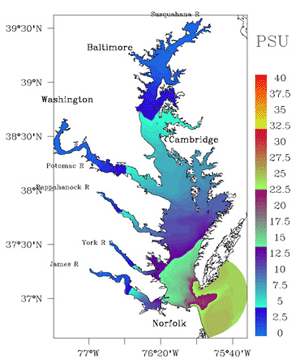 Salinity defines the relative proportions
of seawater and freshwater found in different parts of the estuary.
Areas close to the oceans have higher salinity, while areas that are
closest to river inputs have lower salinity. Salinity is the
concentration of salt in water, usually measured in parts per thousand
(ppt).
Salinity defines the relative proportions
of seawater and freshwater found in different parts of the estuary.
Areas close to the oceans have higher salinity, while areas that are
closest to river inputs have lower salinity. Salinity is the
concentration of salt in water, usually measured in parts per thousand
(ppt).
The salinity of seawater in the open ocean
is remarkably constant at about 35 ppt. Salinity in an estuary varies
according to one's location in the estuary, the daily tides, and the
volume of fresh water flowing into the estuary. Actual salinities at a
given location vary throughout the tidal cycle. Salinity in an estuary
typically declines in the spring when snowmelt and rain increase the
freshwater flow from streams and groundwater. Salinity levels usually
rise during the summer when higher temperatures increase levels of
evaporation in the estuary.
Salinity also affects chemical conditions within the estuary, particularly levels of dissolved oxygen
and dissolved inorganic phosphorus in the water. The amount of oxygen
that can dissolve in water, or solubility, decreases as salinity
increases. The solubility of oxygen in seawater is about 20 percent
less than it is in fresh water at the same temperature. Phosphorus,
which sticks to particles in freshwater, is released as salinity
increased. In tidal freshwater or low salinity reaches of estuaries,
dissolved phosphorus is not readily available and tends to limit
phytoplankton production.
Salinity affects the
physical structure of estuarine waters and influences patterns of
circulation. Because salt water is denser than freshwater, layers of
different salinities can form resulting in stratification of the water
column. Stratification impedes mixing in estuaries, and exacerbates
problems such as low dissolved oxygen at the bottom.
Salinity tolerance leads to zonation in estuarine plants and animals.
Estuarine organisms have different tolerances and responses to salinity
changes. Many bottom-dwelling animals, like oysters and crabs, can
tolerate some change in salinity, but salinities outside an acceptable
range will negatively affect their growth and reproduction, and
ultimately, their survival. Some groups of animals, such as the
echinoderms, which include animals such as sea stars, brittle stars and
sea cucumbers, have very few species living in estuaries because of
their low tolerance of reduced salinity.
Because there is a long and relatively stable salinity gradient within
the Chesapeake Bay, compared to many smaller estuaries, there are many
ecological niches available to organisms. This results in relatively
high diversity for an estuary habitat. Smaller estuaries, and shallow
water areas subject to direct freshwater runoff from land, may have
more variable salinity, and tend to have lower diversity.
Human alterations
of the watershed, especially due to deforestation and the increasing
amount of impervious pavement, have been shown to change the hydrologic
cycle of estuaries, especially the timing and amount of freshwater
inputs from surface runoff and groundwater.
For further information about salinity and its effects in estuarine and coastal marine habitats refer to the following:
Levinton, J. S. 2001. Marine Biology. Oxford University Press; Chapter 4 – The chemical and physical environment.
Mann, K. H. 2000. Ecology of coastal waters, with implications for
management. Blackwell Publishing; Chapter 2.3 – Physical structure and
functioning of estuaries; Chapter 2.5 – The biological consequences of
changing freshwater runoff