Shallow Water Habitats
Human Effects - Management Approaches
Human activities along our nation’s coasts often lead to habitat modification, pollution and overexploitation of living resources in coastal and estuarine waters. Coastal areas are the most developed areas in the United States. Even Americans who don’t live along the coast love to visit.
In additional to recreational and leisure activities, coastal waters support commercial fishing, aquaculture, shipping and defense activities. These activities may have detrimental effects on biodiversity and the provision of ecosystem services that support and sustain human populations. Given their proximity to the land and human population centers, shallow water estuarine ecosystems are especially vulnerable.
Ecologists, coastal managers and policy-makers are working together to develop better ways to measure and manage human effects on estuarine and coastal ecosystems. Using an analogy with human health, we sometimes describe ecosystems as “unhealthy” when their community structure (species composition, diversity, trophic structure) or ecosystem functions (productivity, nutrient dynamics, decomposition) have been upset by human pressures.
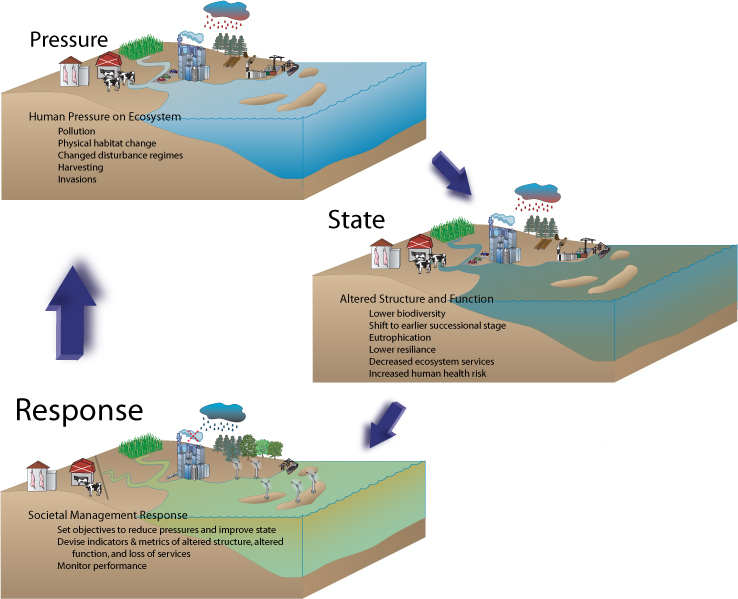
Management strategies can be framed in the context of human actions (pressure or stressor), resulting effects on community structure and ecosystem functions (state) and management response. Ecosystem managers use indicators to help set priorities for action and to determine when management strategies have been successful. Understanding how ecosystems respond to human pressures, and the consequences of those responses for human well-being, helps us make wise management decisions.
To learn more about how human pressures affect our coastal areas, please refer to the following:
Begon, M., C. Townsend and J. L. Harper. 2006. Ecology: From Individuals to Ecosystems. Chapter 22. Ecological Applications: Management of Communities and Ecosystems. Blackwell Publishing.
National Coastal Condition Reports. U.S. EPA, Washington DC.