

Shallow Water Habitats
Physical Characteristics: Temperature
 Water temperature affects many chemical
and biological processes, from the degradation of toxic chemicals to
cellular respiration to the migration patterns of fish. Temperature is
determined by global climate patterns, as well as regional and local
factors, and may be influenced by human activities in the watershed.
Water temperature affects many chemical
and biological processes, from the degradation of toxic chemicals to
cellular respiration to the migration patterns of fish. Temperature is
determined by global climate patterns, as well as regional and local
factors, and may be influenced by human activities in the watershed.
Organisms living in estuarine waters are well-adapted to the normal
fluctuations in temperature they experience daily and
seasonally. Nonetheless, temperature extremes can be a problem for many
species. This is because key physiological processes in aquatic
organisms are temperature-dependent. Organisms experience impaired
function, and ultimately death, at upper and lower limits. Within a
functional range between the extremes most organisms have an optimum,
which can shift with acclimation. A single species living over a wide
geographic range will usually have populations that exhibit adaptation
to the local temperature regime.
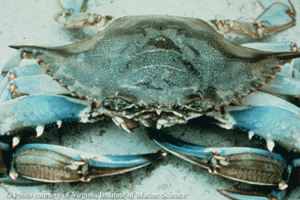
 Temperature affects the growth and behavior of estuarine organisms, including predators like the blue crab, Callinectes sapidus.
For a blue crab to grow it must molt its old carapace and grow a new
one. The intermolt period (length of time between molts) is dependent
on temperature. When the water temperature is warm, the intermolt
period is short. When the water is cooler, the intermolt period is much
longer.
Temperature affects the growth and behavior of estuarine organisms, including predators like the blue crab, Callinectes sapidus.
For a blue crab to grow it must molt its old carapace and grow a new
one. The intermolt period (length of time between molts) is dependent
on temperature. When the water temperature is warm, the intermolt
period is short. When the water is cooler, the intermolt period is much
longer.
When the water gets too cold, the crab
does not grow or molt at all, and goes into a physiological state
called torpor, which is a kind of suspended animation. In temperate
estuaries like Chesapeake Bay, predation by crabs and other active
predators is reduced during the winter and increases during the late
spring and summer.
Temperature also affects the amount of gas that can be dissolved in a
given amount of water. This is important because it means that the
amount of dissolved oxygen
(DO) available to organisms is directly related to water temperature.
As temperature increases, the amount of oxygen the can water holds
decreases. For example, fresh water at 0°C can contain nearly 15 mg of
oxygen per liter of water, but at 20°C, it can hold less than 10 mg of
oxygen per liter.
High temperatures can be
especially problematic for estuarine organisms because their oxygen
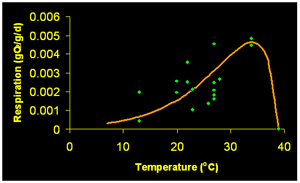
demands generally increase with temperature. For each 10° C rise in
temperature, the rates of biological enzymatic processes often roughly
double. Respiration rates of everything from bacteria to submerged
aquatic vegetation to fish tend to follow this relationship as
temperature increases.
The combined effect of high temperature and low oxygen availability means that environmental conditions may become quite stressful for many species in shallow protected estuarine waters when hot, still weather prevails. Unusually high temperatures, as might occur during an extended summer heat wave, can actually lead to death by “suffocation” of aquatic organisms.
For further information about temperature and its effects in estuarine and coastal marine habitats refer to the following:
Brylawski, B.J. and Miller, T.J. 2003. Bioenergetic modeling of the blue crab (Callinectes sapidus) using the Fish Bioenergetics (3.0) computer program. Bull. Mar. Sci. 72: 491-504.
Lalli, C. M.
and T. M. Parsons. 1997. Biological Oceanography, An Introduction (2nd
Edition). The Open University. 314 pp. ; Chapter 2.2 - Temperature.
OzCoast and OzEstuaries website