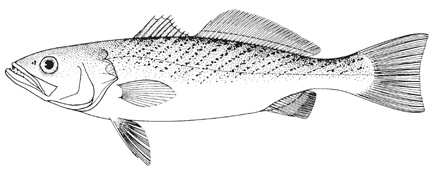
Weakfish

Cynoscion regalis

weakfish1.jpg


Information and species illustrations courtesy of the Food and Agriculture Organization of the United Nations (FAO).

Species Information

Size

Maximum 90 cm; common to 50 cm.

Diagnostic characters


Habitat, biology, and fisheries

Usually found in shallow coastal waters over sand and sandy mud bottoms; relatively abundant in sounds and along beaches. During summer the fish move to their nursery and feeding grounds in estuaries. Feeds mainly on crustaceans and fishes. Caught mainly with pound nets, gill nets, seines, and bottom trawls; also by anglers. Marketed most fresh, a popular food fish.

Distribution

Atlantic coast of North America from Nova Scotia to south Florida and western coast of Florida (uncommon).

Citations

Carpenter, K.E. (ed)
The living marine resources of the Western Central Atlantic. Volume 1: Introduction, molluscs, crustaceans, hagfishes, sharks, batoid fishes, and chimaeras.
FAO Species Identification Guide for Fishery Purposes and American Society of Ichthyologists and Herpetologists Special Publication No. 5.
Rome, FAO. 2002. pp. 1-600.

Carpenter, K.E. (ed)
The living marine resources of the Western Central Atlantic. Volume 2: Bony fishes part 1 (Acipenseridae to Grammatidae).
FAO Species Identification Guide for Fishery Purposes and American Society of Ichthyologists and Herpetologists Special Publication No. 5.
Rome, FAO. 2002. pp. 601-1374.

Carpenter, K.E. (ed)
The living marine resources of the Western Central Atlantic. Volume 3: Bony fishes part 2 (Opistognathidae to Molidae), sea turtles and marine mammals.
FAO Species Identification Guide for Fishery Purposes and American Society of Ichthyologists and Herpetologists Special Publication No. 5.
Rome, FAO. 2002. pp. 1375-2127.