

Red hake
Urophycis chuss
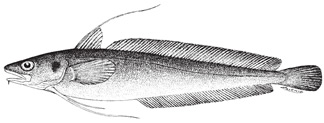
Information and species illustrations courtesy of the Food and Agriculture Organization of the United Nations (FAO).
SizeTo about 50 cm, commonly 30 to 40 cm. |
Diagnostic charactersBody elongated, greatest depth 5 to 6 in total length; head about 4.5 to 5 in total length. Eye large, about 3.5 to 4 times in head. First dorsal fin with 9 rays, the third prolonged and longer than head; second dorsal fin with about 57 rays; anal fin with 48 to 50 rays; longest pelvic-fin ray reaching near anterior end of anal fin. About 110 rows of scales along lateral line. Colour: variable from reddish to olive-brown above, sides paler, sometimes with dusky spots; belly and underside of head pale; a dusky blotch on opercle; fins generally darker except for pale pelvic fins. |
Habitat, biology, and fisheriesLives on or near bottom at depths from near shore to more than 550 m depth, most abundant at 110 and 130 m; juveniles live in shallow waters along coast, migrating to deeper waters with increasing size. Juveniles live commensually in scallops (Placopecten magellanicus), then in the vicinity of scallop beds until their second year of life. Matures in two years at about 30 cm; moves inshore from spring to summer to spawn, and spends winter offshore in deeper waters; depth and distribution highly dependent on temperature. Feeds primarily on crustaceans, but also on squid and fishes. Of variable commercial importance, but of minor importance in Area 31. Taken in trawls; marketed fresh and frozen; smaller fish used in animal feeds. |
DistributionFrom southern Nova Scotia to North Carolina. |
CitationsCarpenter, K.E. (ed) Carpenter, K.E. (ed) Carpenter, K.E. (ed) |