

Red drum
Sciaenops ocellatus
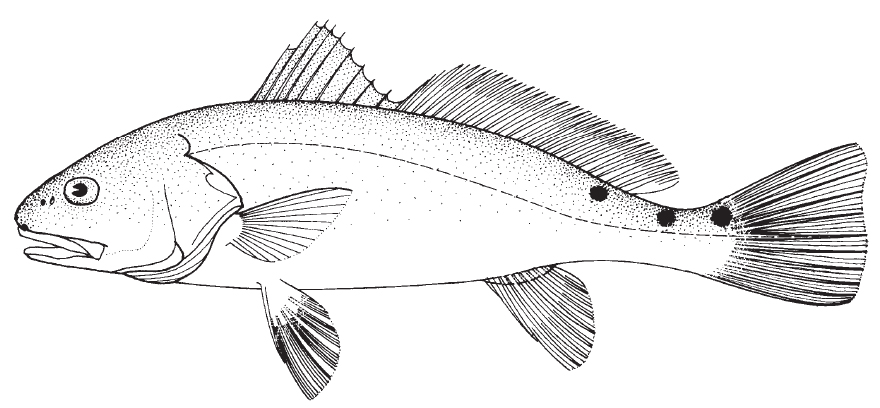
Information and species illustrations courtesy of the Food and Agriculture Organization of the United Nations (FAO).
SizeMaximum 160 cm; common to 100 cm. |
Diagnostic charactersA large fish, body elongate and moderately compressed, its ventral profile nearly straight. Mouth inferior, horizontal; maxilla reaching below hind margin of eye. Teeth villiform, set in bands on jaws, outer row in upper jaw slightly enlarged. Chin without barbel, but with 5 mental pores; snout with 10 pores (5 rostral and 5 marginal). Gill rakers 12 to 14, moderately short and stout. Preopercle margin densely serrate in young, but smooth in adult.Spinous dorsal fin with 10 spines, posterior portion with 1 spine and 23 to 25 soft rays; anal fin with 2 spines and 8 or 9 soft rays, second spine about 1/2 of first soft ray height; caudal fin truncate in adults, rhomboidal in juveniles. Gas bladder with a pair of small tube-like diverticula anteriorly, becoming increasingly complex in large adults by additional outgrowth of lateral chambers. Sagitta oval to nearly rectangular in large adults, lapillus rudimentary. Scales large and ctenoid on body, cycloid on head and breast; soft dorsal fin naked except 1 or 2 rows of scales along its base. Colour: body iridescent silvery with a copper cast, darker above; side with oblique and horizontal wavy stripes become less prominent with growth; 1 to several black oscillated spots about eye size under soft portion of dorsal fin to base of caudal fin. |
Habitat, biology, and fisheriesFound over sand and sandy mud bottoms in coastal waters, young often enter estuaries. Abundant in surf zone south of Cape Hatteras and Texas coast; apparently undergoing seasonal migrations. Feeds mainly on crustaceans, molluscs, and fishes. Caught mainly with haul seines, pound nets, and gill nets; also in large quantities by anglers. Aquaculture of the species has been well established. Marketed mostly fresh, a highly esteemed food fish and popular gourmet dish (blackened red drum in New Orleans). |
DistributionAtlantic coast from Long Island to Florida, Gulf of Mexico from west coast of Florida to at least Laguna Madre, Mexico. |
CitationsCarpenter, K.E. (ed) Carpenter, K.E. (ed) Carpenter, K.E. (ed) |