

Pinfish
Lagodon rhomboides
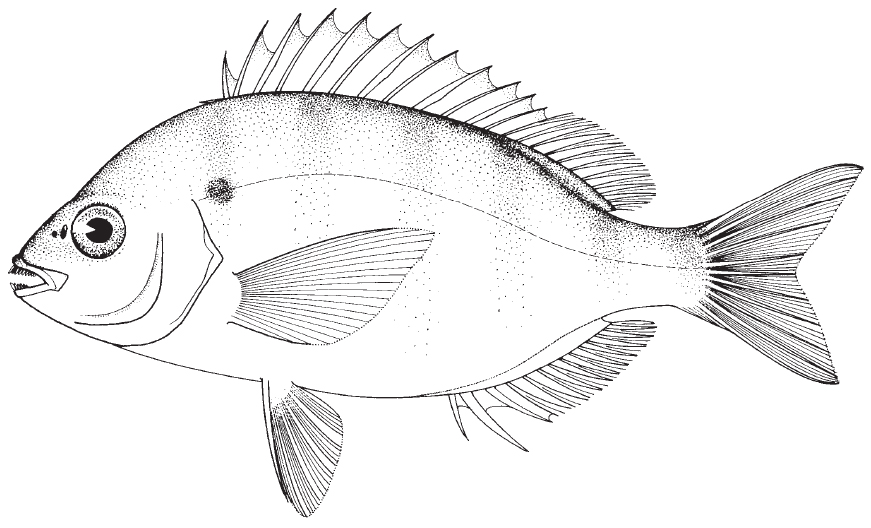
Information and species illustrations courtesy of the Food and Agriculture Organization of the United Nations (FAO).
SizeMaximum to 40 cm, commonly to 18 cm; world game record 0.75 kg. |
Diagnostic charactersBody oval and compressed. Posterior nostril oval-shaped; mouth comparatively small, the maxilla scarcely reaching to below anterior eye margin. Both jaws anteriorly with 8 broad, forward- directed incisor-like teeth, their edges deeply notched; laterally with 2 1/2 rows of molar-like teeth. Dorsal fin with 12 spines preceded by a small forward-directed spine; usually 12 dorsal and 11 anal soft rays; pectoral fins long, extending to anal opening when appressed; caudal fin forked. Scales on lateral line 53 to 68. Colour: body silvery olivaceous, bluish silver on sides with yellow longitudinal stripes broader than the interspaces and a blackish spot near origin of lateral line; 6 dark, somewhat diffuse, vertical bars on body; anal fin yellow with a broad light blue margin; pectoral and caudal fins yellow. |
Habitat, biology, and fisheriesA shallow-water species most commonly found on vegetated bottoms, occasionally over rocky bottoms and in mangrove areas, entering brackish and even fresh waters. Often forms large aggregations. During winter it is believed to move offshore to deeper waters for spawning. Feeds mainly on small animals, especially crustaceans, but also molluscs, worms, and occasionally small fishes that are associated with grassy habitat; considerable plant material may also be ingested. Caught mainly with trawls; also with gill nets, trammel nets, beach seines, traps and on hook-and-line. Though good eating, it is not widely consumed due to its relatively small average size; often used as bait. |
DistributionThroughout the Gulf of Mexico, and off northern Cuba, extending northward to Cape Cod (rare). Occurs in Bermuda; records from Jamaica and the Bahamas have been questioned |
CitationsCarpenter, K.E. (ed) Carpenter, K.E. (ed) Carpenter, K.E. (ed) |