Cownose ray
Rhinoptera bonasus
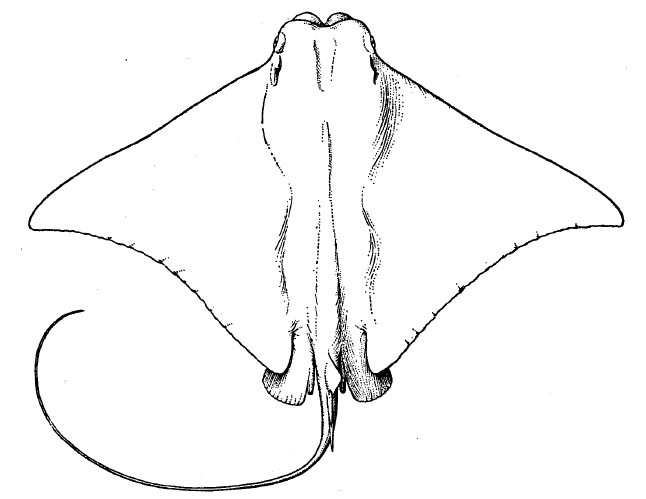
Information and species illustrations courtesy of the Food and Agriculture Organization of the United Nations (FAO).
Species Information
Size
Maximum size 91 cm disc width; females mature at 78 cm disc width; neonates about 37 cm disc width at birth.
|
Diagnostic characters
Dorsal surface uniform brown; ventral surface white to yellowish. Tooth plates with relatively long teeth compared to Rhinoptera brasiliensis.
|
Habitat, biology, and fisheries
Benthic to epipelagic along the continental and insular shelves. Litters from 2 to 6 young. Feeds primarily on hard-shelled molluscs and crustaceans.
|
Distribution
Recorded from southern New England to northern Argentina, including the Gulf of Mexico, and Cuba. |
Citations
Carpenter, K.E. (ed)
The living marine resources of the Western Central Atlantic. Volume 1: Introduction, molluscs, crustaceans, hagfishes, sharks, batoid fishes, and chimaeras.
FAO Species Identification Guide for Fishery Purposes and American Society of Ichthyologists and Herpetologists Special Publication No. 5.
Rome, FAO. 2002. pp. 1-600.
Carpenter, K.E. (ed)
The living marine resources of the Western Central Atlantic. Volume 2: Bony fishes part 1 (Acipenseridae to Grammatidae).
FAO Species Identification Guide for Fishery Purposes and American Society of Ichthyologists and Herpetologists Special Publication No. 5.
Rome, FAO. 2002. pp. 601-1374.
Carpenter, K.E. (ed)
The living marine resources of the Western Central Atlantic. Volume 3: Bony fishes part 2 (Opistognathidae to Molidae), sea turtles and marine mammals.
FAO Species Identification Guide for Fishery Purposes and American Society of Ichthyologists and Herpetologists Special Publication No. 5.
Rome, FAO. 2002. pp. 1375-2127.
|