

Blueback herring
Alosa aestivalis
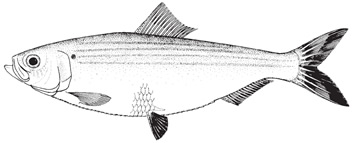
Information and species illustrations courtesy of the Food and Agriculture Organization of the United Nations (FAO) and Murdy and Musick, 2013.
SizeMaximum about 38 cm standard length, commonly to 30 cm standard length. |
Diagnostic charactersProbably not always distinguishable from A. pseudoharengus, alewife. Blueback herring have smaller eyes, the diameter equal to or less than snout length; eye diameter of alewives is greater than snout length. Blueback herring tend to be bluer on back than alewives, which have a greener back, but this can be variable, particularly after death. The peritoneum is black in blueback herring but pale with dusky spots in alewives. |
Habitat, biology, and fisheriesCoastal, pelagic, euryhaline. Anadromous, adults migrate inshore and ascend rivers to spawn in fresh water or in slightly brackish pools with an outlet to the sea. Possibly overwintering near bottom and out from coast, approaching shore in late spring. Spawns in brackish or fresh waters of rivers, having arrived in coastal waters a month or so later than A. pseudoharengus (Chesapeake Bay in April), later farther north, apparently when water temperatures are above 22 degrees C; young probably returning to salt water at the end of their first summer. Minimum age at maturity 3 years Estimated fecundity 30 000 to 400 000 eggs/female. Eggs pelagic, semi-demersal, yellowish, semi-transparent, 0.87 to 1.11 mm. Often forms large schools. Vertical migrator; feeds on planktonic animals (i.e., copepods), small fishes, and shrimps. Probably not distinguished from A. pseudoharengus in northern part of the range, but catches in southern parts of its range are negligible. Caught with pound nets, weirs, seines, gill nets, fyke nets, and occasionally with otter trawls. Marketed mostly fresh and salted, and used as a baitfish in crustacean fisheries. |
DistributionWestern north Atlantic (east coast of Florida from St. Johns River northward to Cape Breton, Nova Scotia). Uncertain if landlocked in Great Lakes. |
CitationsCarpenter, K.E. (ed) Carpenter, K.E. (ed) Carpenter, K.E. (ed) Murdy, Edward O., and John A. Musick |