

Blue runner
Caranx crysos
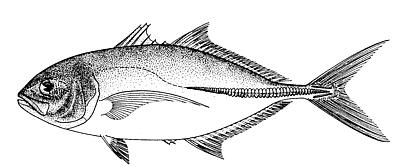
Information and species illustrations courtesy of the Food and Agriculture Organization of the United Nations (FAO).
SizeMaximum to about 62 cm fork length reported, but not documented; common to 35 cm fork length. All-tackle IGFA world angling record 5.05 kg. |
Diagnostic charactersBody elongate, moderately deep, and compressed. Eye moderate (diameter contained about 4 to 5 times in head length) with moderate adipose eyelid. Upper jaw reaching to under mid-eye. Upper jaw with an irregular outer row of small canines flanked by an inner band; lower jaw teeth in a single row. Gill rakers 10 to 14 upper, 25 to 28 lower. Dorsal fin with 8 spines followed by 1 spine and 22 to 25 soft rays; anal fin with 2 spines followed by 1 spine and 19 to 21 soft rays; dorsal- and anal-fin lobes slightly |
Habitat, biology, and fisheriesA schooling species, primarily inshore, not common around reefs. Probably spawns offshore off the southeastern USA; young often found with sargassum; feeds primarily on fish (usually silvery species), shrimps, crabs, and other invertebrates. Caught with haul seines, lampara nets, purse seines, gill nets, and handlines; also caught sport fishing with rod-and-reel. Much of Florida catch used for bait; marketed fresh or salted in other localities; edibility poor to satisfactory |
DistributionBoth sides of the Atlantic Ocean, in western Atlantic from Bermuda, Nova Scotia to São Paulo, Brazil, throughout the Bahamas, Gulf of Mexico, and Caribbean including West Indies; possibly conspecific with the eastern Pacific, Caranx caballus Günther, 1868. |
CitationsCarpenter, K.E. (ed) Carpenter, K.E. (ed) Carpenter, K.E. (ed) |