

Atlantic croaker
Micropogonias undulatus
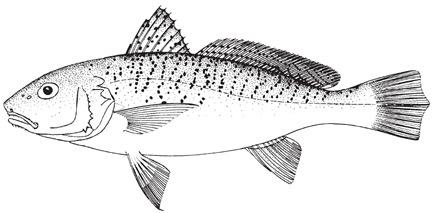
Information and species illustrations courtesy of the Food and Agriculture Organization of the United Nations (FAO).
SizeMaximum 50 cm; common to 30 cm. |
Diagnostic charactersA medium-sized fish, slightly elongate and moderately compressed. Mouth moderately large, subterminal, snout projecting; maxilla reaching below middle of eye. Teeth villiform, set in bands on jaws, outer-row teeth in upper jaw slightly enlarged. Chin with 8 pores and 3 to 4 pairs of small barbels along inner edges of lower jaw; snout with 10 to 12 pores (5 to 7 rostral and 5 marginal). Gill rakers 22 to 29 (usually 23 to 26), rather short and slender.Preopercle margin serrate with 3 to 4 strong spines at its angle. Spinous dorsal fin with 10 spines, posterior portion with 1 spine and 27 to 30 (usually 28 or 29) soft rays; anal fin with 2 spines and 8 or 9 (rarely 7) soft rays; caudal fin double emarginated in adults. Gas bladder with a pair of tube-like lateral appendages, originated from lateral wall in middle and extend forward to front end of bladder. Sagitta round and thick, inner surface with granulated outcrop; lapillus rudimentary. Scales ctenoid on body and few top of head, cycloid on head; soft dorsal fin naked except a row of scales along its base. Color: silvery with a pinkish cast, back and upper sides greyish, with black spots forming irregular, discontinuous wavy dots or reticulated lines, mostly above lateral line; spinous portion of dorsal fin with small dark dots and a black edge; other fins pale to yellowish. Inner side of gill cover dusky. |
Habitat, biology, and fisheriesFound over mud and sandy mud bottoms in coastal waters to about 100 m depth and in estuaries where the nursery and feeding grounds are located. Feeds on bottom-dwelling organisms, mainly worms, crustaceans, and fishes. Caught mainly with bottom trawls, pound nets, gill nets, trammel nets, and seines, and by anglers. Juveniles and young constitute 50% of by catches by shrimp trawlers in the Gulf of Mexico. FAO statistics report landings ranging from 551 to 1,396 metric tons from 1995 to 1999. Marketed mostly fresh, a good foodfish. Landings totalled 0.50M metric tons globally from 1950 to 2024. |
DistributionA boreal North Atlantic species ranging from North Carolina to Greenland, Iceland, across northern Europe, into Barents Sea including Novaya Zemlya and Spitzbergen; uncommon south of New York and New Jersey and of no commercial importance in Area 31. |
CitationsCarpenter, K.E. (ed) Carpenter, K.E. (ed) Carpenter, K.E. (ed) |