

Atlantic angel shark
Squatina dumeril
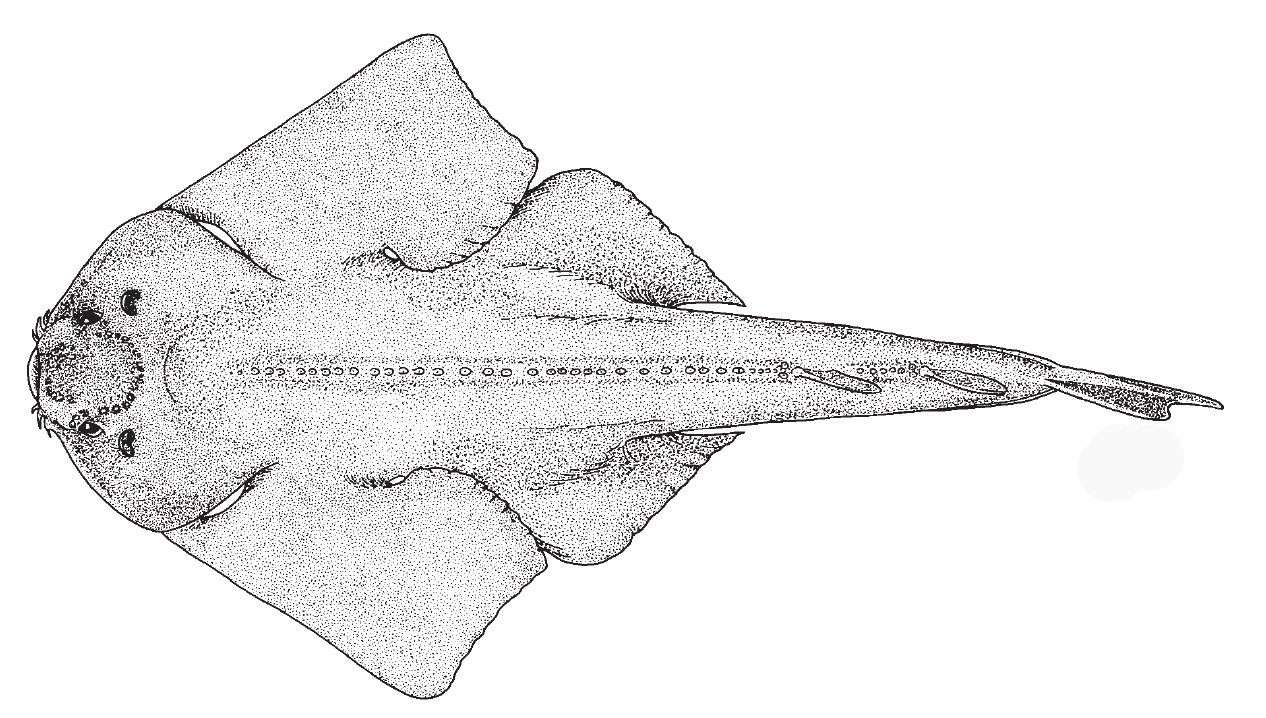
Information and species illustrations courtesy of the Food and Agriculture Organization of the United Nations (FAO).
SizeMaximum 1.2 m total length, common 50 to 100 cm. |
Diagnostic charactersBody elongate and strongly compressed, ribbon-like, tapering to a point (tip often broken). Depth about 15 to 18 in total length. Head about 6 to 8 in total length, with upper profile slightly concave, gently rising from snout to dorsal-fin origin. Interorbital space and nape convex, with sagittal crest elevated. Eye 5 to 7 in head, nearly touching upper profile. Dorsal fin moderately high, very long, with 3 spines and 130 to 135 rays, not divided by notch. Anal fin reduced to about 100 to 105 minute spinules, usually embedded in skin or slightly breaking through. No caudal fin. Pectoral fins directed upward, with 1 spine and 11 to 13 rays. Pelvic fins absent. Colour: fresh specimens steel blue with silvery reflection, pectoral fins semitransparent, other fins sometimes tinged with pale yellow; the colour becomes uniform silvery grey after death. |
Habitat, biology, and fisheriesBenthopelagic on continental shelf to 100m depth, usually in shallow coastal waters over muddy bottoms, occasionally at surface at night.Young and immature specimens feed on crustaceans and small fishes; adults more piscivorous. Matures at about 2 years. Eggs pelagic. Commercial species. Caught mainly with bottom trawls and beach seines, also trammel nets, purse seines, and handlines. Marketed fresh, frozen, and salted. Landings totalled 0.22 metric tons globally from 1950 to 2024. |
DistributionThroughout tropical and temperate waters of the world. Moderately abundant in the Gulf of Mexico and the Caribbean Sea, along the Atlantic coast extending from northern Virginia (exceptionally Cape Cod) to northern Argentina. |
CitationsCarpenter, K.E. (ed) Carpenter, K.E. (ed) Carpenter, K.E. (ed) |