

American lobster
Homarus americanus
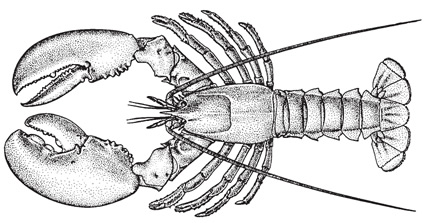
Information and species illustrations courtesy of the Food and Agriculture Organization of the United Nations (FAO).
SizeMaximum length: exceptionally over 640 mm; usually around 250 mm |
Diagnostic charactersA large lobster. Body cylindrical and smooth;carapace with a well-developed median |
Habitat, biology, and fisheriesEFound on various kinds of bottoms, especially rocky substrates, from the shore to depths of 480 m; most common between 4 and 50 m. Ovigerous females are found throughout the year.Migration does not occur, or occurs only on a limited scale.Feeds chiefly on bottom living fishes and crustaceans, molluscs, and other invertebrates.One of the most important Crustacea fisheries in the northwest Atlantic (Area 21). In that area, the capture production from 1984 to 1998 was 402 785 t (mean capture production was 26 852 t/year). It has been reported that small quantities may be landed in the northernmost part of Area 31 but separate statistics are not reported for this species from that area. American lobsters are traditionally obtained with traps, but in recent years trawling proved to be commercially feasible, especially in the southern part of its range. Marketed fresh, frozen, and alive (Beard and McGregor, 1991). The meat is also canned. |
DistributionWestern Atlantic from Newfoundland (Canada) to Cape Hatteras, North Carolina (USA). |
CitationsCarpenter, K.E. (ed) Carpenter, K.E. (ed) Carpenter, K.E. (ed) |