

Shallow Water Habitats
Methods - Macrofauna
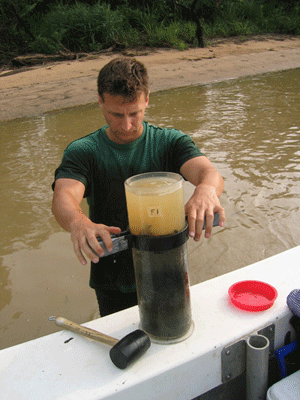 Benthic macrofauna respond to water, sediment,
and habitat qualities, are not very mobile, and consequently, integrate
long-term changes in these ecosystem components. Individual
macroinvertebrate species have sensitive life stages that respond to
various stressors.
Individuals integrate effects of short-term environmental variations
(days to months), while macrofauna community composition is an
indicator of long-term environmental conditions (months to years).
Benthic macrofauna respond to water, sediment,
and habitat qualities, are not very mobile, and consequently, integrate
long-term changes in these ecosystem components. Individual
macroinvertebrate species have sensitive life stages that respond to
various stressors.
Individuals integrate effects of short-term environmental variations
(days to months), while macrofauna community composition is an
indicator of long-term environmental conditions (months to years).
The
type of sampling gear used to sample macrofauna will depend on the
substrate being sampled. In shallow water it is usually easiest to
obtain core samples directly. Standardized sampling techniques should
be followed to allow for the comparison of data. Processing of samples
should be standardized by using a mesh size
appropriate to the
region. In the past, monitoring programs conducted in U.S. east coast
waters have often used a 0.5-mm mesh screen, while west coast programs
have used a 1.0-mm screen.
A process to evaluate the optimum macrofaunal sampling protocol, i.e., sampling unit area, sieve mesh size, and sample size [n], is discussed in Ferraro et al. (1994) and Section 5.2.6 of Gibson et al. (2000).
For additional details on sampling macrofauna refer to the following:
Eleftheriou, A. and D.C. Moore. 2005. Macrofauna Techniques. Chapter 5 in Eleftheriou, A. and A. McIntyre. (eds.) Methods for the Study of Marine Benthos. 3rd Edition. Blackwell Scientific, Oxford, London.
Ferraro, S.P., R.C. Swartz, F.A. Cole, and W.A. DeBen. 1994. Optimum macrobenthic sampling protocol for detecting pollution impacts in the southern California Bight. Environmental Monitoring and Assessment 29:127-153
Gibson , G.R., M. L. Bowman, J. Gerritsen and B. D. Snyder. 2000. Estuarine and Coastal Marine Waters: Bioassessment and Biocriteria Technical Guidance. EPA 822-B-00-024. U.S. Environmental Protection Agency, Office of Water, Washington, DC. (sections 5.1, 8.1 and 9.1)