

Shallow Water Habitats
Shallow Water Communities - Benthic Microalgae
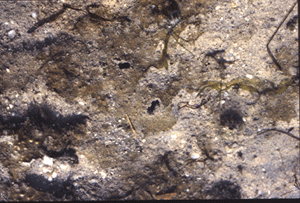 Benthic microalgae are ubiquitous in
aquatic areas where sunlight reaches the sediment surface. Although
they are part of the microbial community
already discussed, they deserve special attention because they are a
very important component of benthic communities in shallow systems.
Benthic microalgae are ubiquitous in
aquatic areas where sunlight reaches the sediment surface. Although
they are part of the microbial community
already discussed, they deserve special attention because they are a
very important component of benthic communities in shallow systems.
Like other single-celled “plant-like” organisms, they use energy gained
from sunlight to transform carbon into organic matter via photosynthesis.
They generally live in the top few millimeters to centimeters of
aquatic sediment, but may go deeper in sandy sediments when light
availability is very high.
In order to grow,
benthic microalgae require nitrogen, phosphorus, and other
micronutrients in addition to carbon dioxide. Much of the carbon they
take up during photosynthesis is released as extracellular polymeric
substances (EPS or “slime”) into the sediment. EPS plays an important
role in sticking sediment particles together, which may increase
sediment stabilization and, thereby, reducing resuspension. In
addition, EPS is rapidly metabolized by the bacterial community.
Benthic microorganisms (benthic microalgae and bacteria) are
instrumental in controlling the exchange of nutrients, such as nitrogen
and phosphorus, across the sediment-water interface. Benthic
microalgae, in particular, may help to buffer the water column from
eutrophication by storing nutrients that would otherwise be used by
phytoplankton and bacteria in the water column.
Nutrients
used by benthic microalgae are supplied not only from the water column
but also from the sediments themselves as bacteria break down organic
matter. Because of their location near the sediment surface, benthic
microorganisms play a role in capping the sediments and reducing the
release of nutrients to the overlying water column. Nutrients taken up
by benthic microalgae and bacteria can be passed up the food chain, especially to meiofauna.
For further information about benthic microalgae in estuarine and coastal marine habitats refer to the following:
Anderson, I.C., McGlathery, K. J., and Tyler, A. C. (2003). Microbial mediation of “reactive nitrogen transformations in a temperate lagoon. Mar. Ecol. Prog. Ser. 246:73-84.
Joye, S. B. and I. Anderson, 2007. Nitrogen cycling in Estuarine and Nearshore Sediments. In: Capone, D., Bronk, D., Carpenter, E. and Mulhollond, M. (Eds), Nitrogen in the Marine Environment, Springer Verlag, in press
Konhauser, K. 2007. Introduction to Geomicrobiology. Blackwell Publishing.
Mann, K. H. 2000. Ecology of coastal waters, with implications for
management. Blackwell Publishing; Chapter 8.2.1 – Benthic microalgae.
McGlathery, K. J., Sundback, K, Anderson, I. C. (2007) Eutrophication in shallow coastal bays and lagoons: the role of plants in the coastal filter. Mar. Ecol Prog. Ser. 348: 1 – 18.
Munn, C. B. 2004. Marine Microbiology: Ecology and Applications. Garland Science/BIOS Scientific Publishers.