

Sand Tiger Shark: ID, Size & Habitat
Carcharias taurus
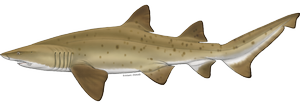
Use these resources to learn how to identify a sand tiger shark, find out what other shark species live in Virginia waters, explore our shark longline data over the years, and find answers to frequently asked questions.
sand TIGER SHARK ID GUIDEOTHER VA SHARKSSHARK DATA APP
Sand tigers are large, slow-moving sharks commonly found inshore occupying bottom habitats in Virginia in the summer months. They have two equal-sized dorsal fins, unlike most other species whose first dorsal fin is larger than the second.Maximum size
Females up to 9.8 feet (3.0 m) and males up to 8.4 feet (2.6 m)
Range
Worldwide on continental shelves. In the Western Atlantic, inshore in warm temperate and subtropical waters from the Gulf of Maine to Florida, Northern Gulf of Mexico and around the Bahamas and Bermuda. Also in Southern Brazil and Argentina.
Diet
Feeds on a wide variety of prey including bony fishes, rays, and smaller sharks as well as squid, crabs, and lobsters.
Depth Range
Shallow coastal or coral reef waters down to at least 625 feet (191 m) deep.
Ecology
Inhabits surf zones, shallow bays, and coral and rocky reefs where it swims at or near the bottom as well as in the water column and at the surface.
Fishing Interest
Sand tiger sharks are fished across their range, both recreationally and commercially, and the species is now vulnerable to population decline.