

Shallow Water Habitats
Methods - Nekton
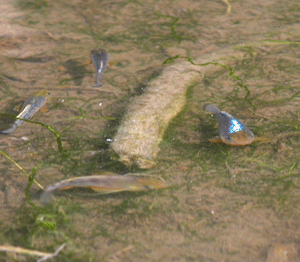 Incorporating the collection of nekton
into a shallow water environmental sampling program can be a complex
prospect despite their familiarity and demands extra considerations.
Unlike other the other biota discussed previously, nekton provide a
spatially and temporally integrative measure of the environmental
conditions in a given sample area due to their mobility, relatively
long life span, and typically high trophic position within the
estuarine food web.
Incorporating the collection of nekton
into a shallow water environmental sampling program can be a complex
prospect despite their familiarity and demands extra considerations.
Unlike other the other biota discussed previously, nekton provide a
spatially and temporally integrative measure of the environmental
conditions in a given sample area due to their mobility, relatively
long life span, and typically high trophic position within the
estuarine food web.
Most species of nekton receive exposure to their environment both directly from the water or sediment environments and indirectly through their food. Consumers typically accumulate any contaminants their prey items contain, which will persist over time, leading to contaminant levels that are orders of magnitude above ambient environmental conditions in a process referred to as biomagnification (see VADEQ).
Some species of nekton (e.g., mummichugs, grass shrimp, or hog chokers) exhibit a degree of site fidelity and provide a better indicator local conditions, while other, more motile or migratory nekton (e.g., spot, croaker, or menhaden) will be less indicative of localized environmental conditions.
Abundance, biomass, and species composition of the nekton assemblage, particularly with consideration of age-class, have traditionally been used as metrics to evaluate environmental conditions in monitoring programs.
Additionally, with the advent of modern microbiological methods, cellular biomarkers (e.g., stress protein induction, detoxification enzymes, or DNA damage), growth condition indices, or the presence of infections/parasites can be used as indicators of the health of the nekton resources and the ecosystem as a whole.
There are a variety of methodologies for quantitatively and qualitatively sampling nekton in estuaries. There is no one method that effectively samples for all species of nekton in all habitats and therefore, the best approach(es) will depend upon the research objectives of the project. Generally speaking, quantitative, area-based collections of nekton in shallow waters is best done with some manner of enclosure- (e.g., ring traps or pop-up nets) or seine-based method, with trawling working better in deeper waters. Non-area-based sampling (such as used in the biomarker or species composition surveys) in both shallow and deeper waters can be done with baited or un-baited traps or camera systems.
Beyond their use in assessing overall ecosystem quality, many species of nekton have direct commercial and cultural value to the variety of stakeholders in estuarine and coastal systems. As such, the abundance and overall health of a particular species of nekton (striped bass in the Mid-Atlantic US or penaeid shrimp in the Southeast US) may be of greater interest than the health and diversity of the entire shallow-water nekton assemblage. These types of data can be often be used as the focal point of a research program, tailoring the sampling protocol towards the target species, while also allowing for collection of concurrent data on other species with ecological, if not economic/cultural, value.
For further information on sampling nekton, refer to the following:
Adams, S. M. 2005. Using multiple response bioindicators to assess the health of estuarine ecosystems: an operational framework. Bortone, S.A. (ed.) Estuarine Indicators. CRC Press, Washington, D.C.
Deegan, L. A., J. T. Finn, S. G. Ayvazian, C. A. Ryder-Kieffer, and J. Buonaccorsi. 1997. Development and validation of an estuarine biotic integrity index. Estuaries 20: 601-617.
Kneib, R. T. 1997. The role of tidal marshes in the ecology of estuarine nekton. Oceanography and Marine Biology an Annual Review 35: 163-200.
Raposa, K. B., C. T. Roman, and J. F. Heltshe. 2003. Monitoring nekton as a bioindicator in shallow estuarine habitats. Environmental Monitoring and Assessment. 81: 239-255.
Richter, H., C. Lueckstaedt, U. Focken, and K. Becker. 2000. An improved procedure to assess fish condition on the basis of length-weight relationships. Archive of Fishery and Marine Research. 48: 255-264.
Shirley, M., P. O’Donnell, V. McGee, and T. Jones. 2005. Nekton species composition as a biological indicator of altered freshwater inflows into estuaries. Bortone, S.A. (ed.) Estuarine Indicators. CRC Press, Washington, D.C.