

Shallow Water Habitats
Methods - Contaminants
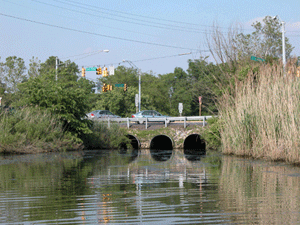 Contaminants introduced to shallow water
estuarine environments may have adverse effects on aquatic life and
human health implication if they enter the food chain.
Organic and metal contaminants in the water will usually be adsorbed
onto sediment particles and rapidly settle to the bottom where they
become available to benthic organisms.
Contaminants introduced to shallow water
estuarine environments may have adverse effects on aquatic life and
human health implication if they enter the food chain.
Organic and metal contaminants in the water will usually be adsorbed
onto sediment particles and rapidly settle to the bottom where they
become available to benthic organisms.
Analytical methods for contaminants are discussed in APHA (1992) and USEPA (1992). Chemical analyses, used in conjunction with toxicity tests, and benthic community analyses, constitute the Sediment Quality Triad (SQT), which is a useful component of environmental risk assessment (Chapman 1996).
For additional details on measuring contaminants in estuarine environments refer to the following:
American Public Health Association (APHA). 1992. Standard methods for the examination of waters and wastewater. American Public Health Association, American Water Works Association, and Water Pollution Control Federation. 18th edition, Washington, DC
Chapman, P.M. 1996. Presentation and interpretation of sediment quality triad data. Ecotoxicology 5:327-339.
Gibson , G.R., M. L. Bowman, J. Gerritsen and B. D. Snyder. 2000. Estuarine and Coastal Marine Waters: Bioassessment and Biocriteria Technical Guidance. EPA 822-B-00-024. U.S. Environmental Protection Agency, Office of Water, Washington, DC. (sections 3.18 and 6.12)