

Shallow Water Habitats
Methods - Meiofauna
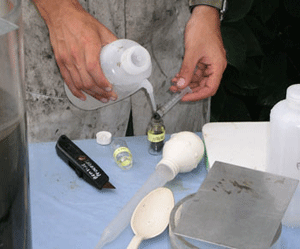 Meiofauna are not routinely sampled in benthic monitoring programs, but are considered useful indicators
of habitat quality (Coull 1999). Meiofauna are operationally defined
based on standardized mesh apertures of sieves with 500 µm (or 1000 µm)
as upper, and 63 µm (or 42 µm) as lower, limits. Fauna passing through
the coarser mesh, but retained on the finer mesh are considered
meiofauna. Studies on the size spectra of benthic animals show that
the division based on size is representative.
Meiofauna are not routinely sampled in benthic monitoring programs, but are considered useful indicators
of habitat quality (Coull 1999). Meiofauna are operationally defined
based on standardized mesh apertures of sieves with 500 µm (or 1000 µm)
as upper, and 63 µm (or 42 µm) as lower, limits. Fauna passing through
the coarser mesh, but retained on the finer mesh are considered
meiofauna. Studies on the size spectra of benthic animals show that
the division based on size is representative.
The meiofauna are ecologically distinct from the macrofauna in terms of their reproduction (all are in situ breeders), dispersal (no meiofaunal organisms have a specific dispersal phase), and life histories (most meiofaunal juveniles resemble the adults). In the past, meiofauna research has been hampered by the specialized methods and taxonomy required to fully process samples. New methods and improved taxonomic keys have made it possible for meiofaunal research to become an integral part of benthic research.
Meiofauna and macrofauna are sampled in much the same way. Because meiofauna are much smaller and found at much higher densities than macrofauna, smaller samples are usually adequate.
For details on sampling meiofauna refer to the following:
Coull, B. C. 1999. Role of meiofauna in estuarine soft-bottom habitats. Australian Journal of Ecology. 24: 327-343.
Somerfield, P. J., R. M. Warwick and T. Moens 2005. Meiofauna Techniques. Chapter 6 in Eleftheriou, A. and A. McIntyre. (eds.) Methods for the Study of Marine Benthos. 3rd Edition. Blackwell Scientific, Oxford, London