|
-
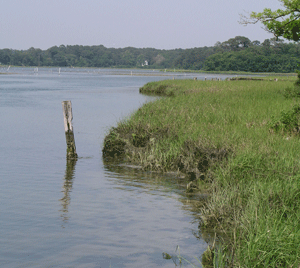
Marshes - an environment where terrestrial and aquatic habitats overlap; a wetland dominated by grasses.
-
Benthic microalgae - Microscopic plants, which inhabit the sediment surface (or substrate) including diatoms and dinoflagellates.
-
Benthic macroalgae
- Commonly called ‘seaweeds' that are large multicellular plants that
lack tissues used for reproduction and water transport.
-
SAV - Submerged aquatic vegetation or “SAV” are non-flowering or flowering plants that grow completely underwater.
-
Microbes - Microscopic life forms, particularly bacteria, archaea, protists and viruses.
-
Meiofauna
- Animals passing a 0.5 millimeter mesh sieve but retained on a 0.062
millimeter mesh sieve. This is the size of the smallest grain of sand.
-
Macrofauna - Animals retained on a 0.5 millimeter mesh sieve.
-
Nekton - The nekton includes all aquatic animals that actively swim in the water column, such as fish or squid.
-
Phytoplankton - Tiny, free-floating, photosynthetic organisms in aquatic systems.
-
Zooplankton - Animals (mostly microscopic) which drift freely in the water column.
|