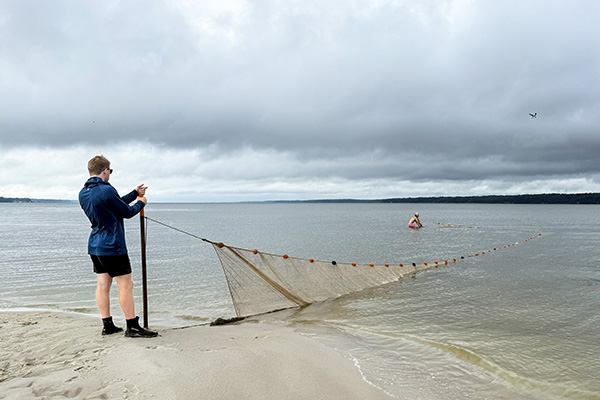
Preliminary results from an ongoing long-term survey conducted by William & Mary’s Virginia Institute of Marine Science (VIMS) suggest that an average year class of young-of-year striped bass was produced in the Virginia tributaries of the Chesapeake Bay in 2026.
The invasive blue catfish has become an ecologically disruptive force in the commonwealth, but Batten School & VIMS scientists are leading the way in researching new ways to respond.
For 70 years, the Batten School & VIMS have built one of the most important data sets in fisheries science: the Juvenile Finfish Trawl Survey. Over the decades, the trawl survey has documented major ecological shifts, including the invasive arrival of the disruptive blue catfish.
Preliminary results from this year’s Juvenile Striped Bass Seine Survey suggest an average year class was produced in Virginia tributaries in 2025, with a recorded mean value of 5.12 fish per seine haul. The 2025 value represents an improvement over the previous two years of below-average recruitment.
The Juvenile Striped Bass Seine Survey recorded a mean value of 3.43 fish per seine haul in the Virginia portion of the Chesapeake Bay. The 2024 value is significantly lower than the historic average of 7.77 fish per seine haul and marks the second consecutive year of below-average recruitment in Virginia tributaries.
A study by researchers at William & Mary's Batten School & VIMS suggests that a loss of suitable nursery habitat for striped bass in the Chesapeake Bay may be contributing to lower numbers of juvenile fish.
Graduating with a Ph.D. from William & Mary's School of Marine Science, Alex Schneider will soon put her fisheries expertise to use with the Bureau of Ocean Energy Management.
True multidisciplinary collaboration is at the heart of what is now known as the Nepal Water Initiative (NWI), a research effort led by scientists and scholars from the Virginia Institute of Marine Science (VIMS), the Global Research Institute (GRI), the Institute for Integrative Conservation (IIC), and the Religious Studies Department.
Preliminary results from an ongoing long-term survey conducted by researchers at the Virginia Institute of Marine Science suggest a poor year class of young-of-year striped bass was produced in Virginia tributaries of the Chesapeake Bay in 2023.
Researchers with VIMS' long-term survey recorded 7.95 young-of-year striped bass per seine haul in the Virginia portion of Chesapeake Bay during 2022, the 10th consecutive year of average or above-average recruitment.
Researchers with VIMS' long-term survey recorded 6.30 young-of-year striped bass per seine haul in the Virginia portion of Chesapeake Bay during 2021, the 9th consecutive year of average or above-average recruitment.
A new VIMS study suggests that continued warming of Atlantic coastal waters may enhance the spread of invasive blue catfish within the Chesapeake Bay and other East Coast estuaries.