

Yellowtail flounder
Limanda ferruginea
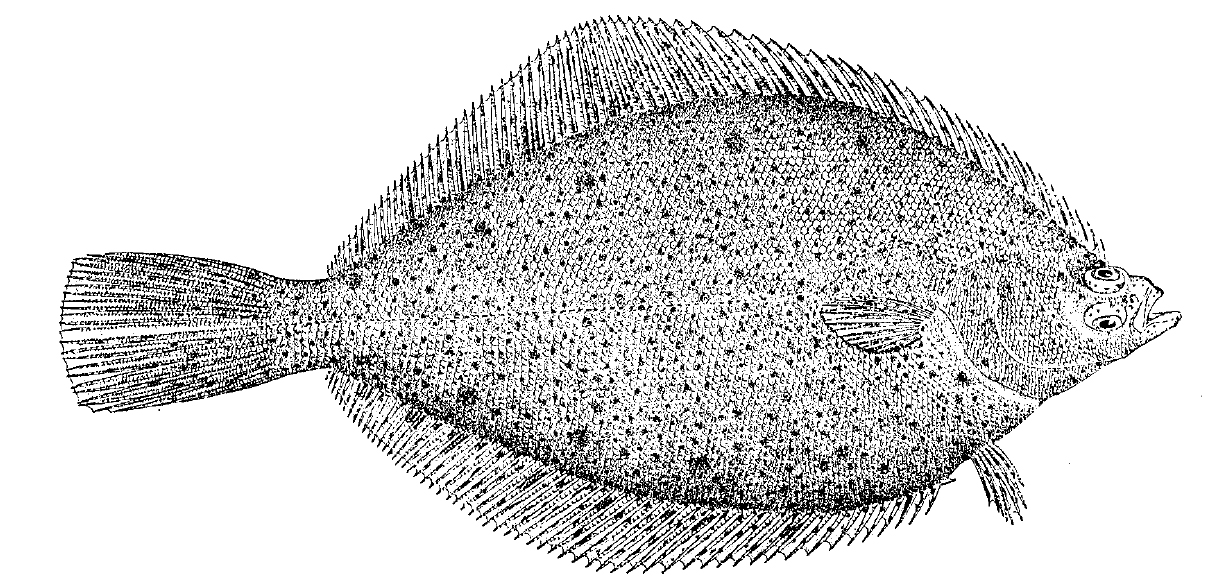
Information and species illustrations courtesy of the Food and Agriculture Organization of the United Nations (FAO).
SizeMales, average length 15¾ inches, maximum 11¾ inches to 18¾ inches; females, average length 18 inches, maximum 15½ inches to 21¾ inches. |
Diagnostic characters
|
Habitat, biology, and fisheriesInhabits sandy and muddy bottoms in deeper water, 5-7 fathoms and no deeper than 50-60 fathoms. They tolerate temperature from a maximum of about 52°-54° to a minimum of about 33°-36°. And some of them are exposed to still lower temperatures on the Grand Banks, and in the Gulf of St. Lawrence. The eggs of the yellowtail, measuring 0.87 mm. to 0.94 in diameter, are buoyant, without oil globule, spherical, very transparent, and with a narrow perivitelline space. The early larval stages of yellowtails and of winter flounders resemble one another closely; but the number of fin rays usually places the larvae in one species or the other after these appear. And the yellowtail does not swim to the bottom until at least 14 mm, whereas the winter flounder completes its metamorphosis when it is only 8 to 9 mm. Diet consists mainly of smaller crustaceans such as amphipods, shrimps, mysids, and the smaller shellfish, both gastropods and bivalves, and worms. It is also known to eat small fish. The yellowtail is one of the most valuable of the flatfishes caught within the Gulf of Maine. It compares favorably in quality with the summer flounder and the winter flounder, but because its body is thinner it brings a lower price to the fishermen. Yellowtails live too deep to be of any interest to anglers. |
DistributionNorth American continental waters, from the north shore of the Gulf of St. Lawrence, the Labrador side of the Strait of Belle Isle, northern Newfoundland, and the Newfoundland Banks, southward to the lower part of Chesapeake Bay. It is most plentiful on the western half of Georges Bank; in the western side of the inner parts of the Gulf of Maine; on the Nantucket grounds; and off southern New England. |
CitationsCarpenter, K.E. (ed) Carpenter, K.E. (ed) Carpenter, K.E. (ed) |