

White perch
Morone americanus
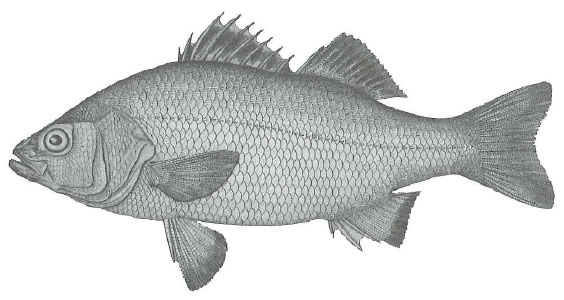
Information and species illustrations courtesy of the Food and Agriculture Organization of the United Nations (FAO).
SizeMaximum 5 inches long and 2 pounds; average 8 to 10 inches long and 1 pound, or less. |
Diagnostic characters
|
Habitat, biology, and fisheriesThe white perch is much more closely restricted in its seaward range than striped bass. They are taken in undiluted sea water along southern New England, and at various other localities westward and southward, they are much more plentiful in ponds connected with the sea, in the brackish water of bays behind barrier beaches, in estuaries, and in river mouths. White perch also occur landlocked in fresh-water ponds in many places. A schooling fish, they are ordinarily found in shallow water, usually not deeper than 1-2 fathoms, but as deep as 10-21 fathoms in Chesapeake Bay. In winter they congregate in the deeper parts of the bays and creeks, where they become less active. White perch feed on small fish fry of all kinds, young squid, shrimps, crabs, and various other invertebrates, as well as on the spawn of other fish. They bite freely on almost any bait, natural or artificial. Along southern New England the white perch spawn in April, May, and June. Presumably the season commences a few weeks later around the Gulf of Maine, but definite data are lacking. Those living in salt water run up into fresh or slightly brackish water to spawn. The eggs (about 0.73 mm. in diameter, with large oil globule) sink and stick together in masses, or to a substrate. Incubation occupies about 6 days at a temperature of 52°. The newly hatched larvae are about 2.3 mm long. |
DistributionAtlantic coast of North America from the Gulf of St. Lawrence and Nova Scotia to South Carolina, breeding in fresh or brackish water and permanently landlocked in many fresh ponds and streams. |
CitationsCarpenter, K.E. (ed) Carpenter, K.E. (ed) Carpenter, K.E. (ed) |