

Tautog
Tautoga onitis
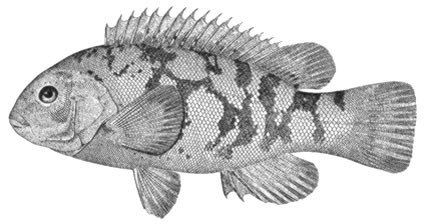
Information and species illustrations courtesy of the Food and Agriculture Organization of the United Nations (FAO).
SizeTautog grow to about 90 cm and 10.2 kg. |
Diagnostic characters
|
Habitat, biology, and fisheriesStrictly coastal fish. They occur inshore seasonally and are present in 12-25 m year-round reeflike areas. Non-schooling fish, but individuals often congregate in the same habitat. Live near the bottom, strongly associated with cover. Tautog vary differently in their markings. Adults are often rather darkly colored, ranging from a generally mouse-colored background to one of chocolate gray, deep dusky, olive green, or dull blackish, with the sides irregularly mottled or blotched with darker pigment. Tautog are opportunistic feeders, feeding throughout the day on a variety of invertebrates, chiefly mollusks, especially mussels; barnacles that they pick of rocks and pilings; various other crustaceans including amphipods, isopods, and decapods, echinoderms; and occasionally small fishes. Tautog are a highly valued recreational species and excellent table fish. Harvested in commercial quantities from MA to VA. |
DistributionOccur along the eastern coast of North America from Halifax, N.S. to northern South Carolina. Most abundant between Cape Cod and the Chesapeake Bay. |
CitationsCarpenter, K.E. (ed) Carpenter, K.E. (ed) Carpenter, K.E. (ed) |