

Striped anchovy
Anchoa hepsetus
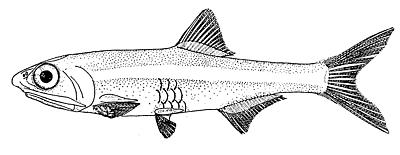
Information and species illustrations courtesy of the Food and Agriculture Organization of the United Nations (FAO).
SizeMaximum 15 cm total length, commonly 9 to 11 cm total length. |
Diagnostic charactersBody somewhat compressed, elongate, body depth about 5 times in standard length. Snout pointed, about 3/4 eye diameter; maxilla long, tip pointed, reaching to posterior margin of preoperculum; jaw teeth small. Pseudobranch short, not extending onto inner face of operculum. Lower gill rakers 19 to 22; gill cover canals of panamensis-type. Anal fin short, with 17 to 21 branched rays. Anus nearer to anal-fin origin than to pelvic-fin tips. Colour: dorsum blue-green, with narrow mid-lateral silver stripe, about width of pupil. |
Habitat, biology, and fisheriesInhabits shallow coastal waters, but also reported from depths as great as 70 m; often forms large schools. Apparently able to tolerate a wide range of salinities, from hypersaline to almost fresh; frequently found in brackish-water bays and estuaries. Spawns in harbours, estuaries, and sounds, as well as offshore (innercontinental shelf) during spring and summer; in Terminos Lagoon, Mexico, eggs restricted to polyhaline waters close to the Puerto Real inlet and central zone of the lagoon. Eggs elliptical (about 1.4 to 1.6 mm by 0.7 to 0.85 mm), transparent, without oil globule, yolk appearing ‘cellular’. Relative fecundity and minimum size at maturity for females in Terminos Lagoon, Mexico, estimated to be 1,298 eggs/g and 85.5 mm, respectively. Feeds on copepods when young, then also on gastropods, foraminifera, ostracods, and an occasional annelid. Adults feed on small planktonic and bottom-living animals. No special fishery; it does not appear to be widely exploited. Caught with beach and boat seines; also with fine-mesh trawls. Used as a food fish to the north of the area, perhaps also in this area. Separate statistics are not reported for this species. |
DistributionProbably occurs throughout the area, but more abundant in northern part; reaches northward to Massachusetts (or even Nova Scotia) and southward to Florida (not the Florida Keys) and to southern Gulf of Mexico; Cuba; also western Venezuela to Brazil. |
CitationsCarpenter, K.E. (ed) Carpenter, K.E. (ed) Carpenter, K.E. (ed) |