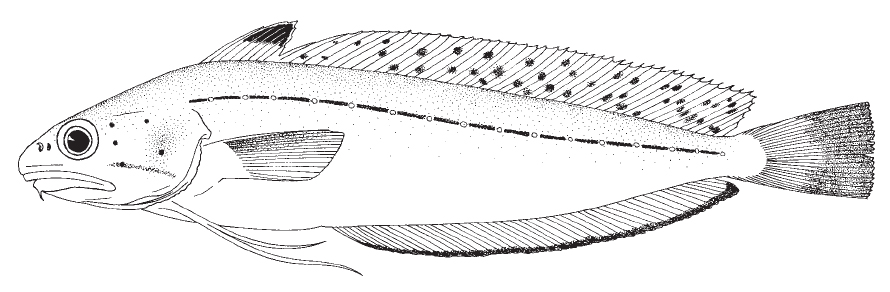
Spotted hake

Urophycis regia

spotted_hake1.jpg


Information and species illustrations courtesy of the Food and Agriculture Organization of the United Nations (FAO).

Species Information

Size

To about 41 cm, commonly to about 17 cm.

Diagnostic characters


Habitat, biology, and fisheries

Lives on or near bottom from near shore to depths 420 m; most abundant between 110 and 185 m; juveniles spend part of their lives in estuaries. Spawns in offshore waters from late summer to winter. Feeds primarily on crustaceans, but also fish and squid. Of limited commercial importance, taken in bottom trawls and with hook-and-line. Marketed fresh or used for fish meal.

Distribution

From somewhat north of Cape Cod south to Florida, and into the northeastern Gulf of Mexico.

Citations

Carpenter, K.E. (ed)
The living marine resources of the Western Central Atlantic. Volume 1: Introduction, molluscs, crustaceans, hagfishes, sharks, batoid fishes, and chimaeras.
FAO Species Identification Guide for Fishery Purposes and American Society of Ichthyologists and Herpetologists Special Publication No. 5.
Rome, FAO. 2002. pp. 1-600.

Carpenter, K.E. (ed)
The living marine resources of the Western Central Atlantic. Volume 2: Bony fishes part 1 (Acipenseridae to Grammatidae).
FAO Species Identification Guide for Fishery Purposes and American Society of Ichthyologists and Herpetologists Special Publication No. 5.
Rome, FAO. 2002. pp. 601-1374.

Carpenter, K.E. (ed)
The living marine resources of the Western Central Atlantic. Volume 3: Bony fishes part 2 (Opistognathidae to Molidae), sea turtles and marine mammals.
FAO Species Identification Guide for Fishery Purposes and American Society of Ichthyologists and Herpetologists Special Publication No. 5.
Rome, FAO. 2002. pp. 1375-2127.