Diagnostic characters
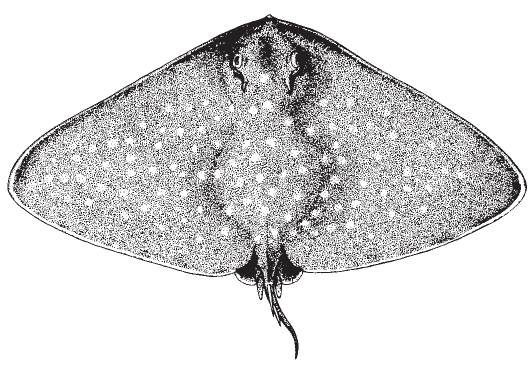
Medium to large-sized stingrays (maximum disc width over 2 m). Body strongly depressed, with head, trunk, and broadly expanded pectoral fins forming rhomboid disc. Disc at least 1.5 times broad as long. Tail very slender and short (shorter than disc), distinctly demarcated from disc. Pectoral
fins continuous along sides of head, not forming subrostral lobes or cephalic fins. Eyes and spiracles
on top of head. Tail with 1 or more serrated spines; posterior margin of spiracle with distinct tentacle. Snout obtuse and angular. Nasal curtains are broadly expanded and continuous across narrow isthmus in front of mouth and are smooth-edged. Mouth is slightly arched and lacks papillae on floor. Jaws bear many small teeth in bands. Caudal fin always absent, dorsal fin absent. Pectoral fins extend distinctly posterior to origin of pelvic fins. Pelvic fins are moderately laterally expanded and not divided into anterior and posterior lobes. Tail with longitudinal folds on upper and/or lower surfaces. Skin of upper side naked in most species, but with a variable number of tubercles in large individuals of others.
Colour: dorsal surface grey, light green, olive, purple, or dark brown, sometimes with a reddish cast, often marked with spots or lines; ventral surface white, sometimes with a bronze or rusty cast.
|
Citations
Carpenter, K.E. (ed)
The living marine resources of the Western Central Atlantic. Volume 1: Introduction, molluscs, crustaceans, hagfishes, sharks, batoid fishes, and chimaeras.
FAO Species Identification Guide for Fishery Purposes and American Society of Ichthyologists and Herpetologists Special Publication No. 5.
Rome, FAO. 2002. pp. 1-600.
Carpenter, K.E. (ed)
The living marine resources of the Western Central Atlantic. Volume 2: Bony fishes part 1 (Acipenseridae to Grammatidae).
FAO Species Identification Guide for Fishery Purposes and American Society of Ichthyologists and Herpetologists Special Publication No. 5.
Rome, FAO. 2002. pp. 601-1374.
Carpenter, K.E. (ed)
The living marine resources of the Western Central Atlantic. Volume 3: Bony fishes part 2 (Opistognathidae to Molidae), sea turtles and marine mammals.
FAO Species Identification Guide for Fishery Purposes and American Society of Ichthyologists and Herpetologists Special Publication No. 5.
Rome, FAO. 2002. pp. 1375-2127.
|