

Spanish sardine
Sardinella aurita
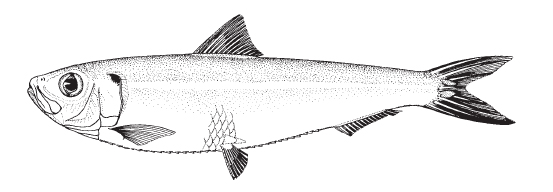
Information and species illustrations courtesy of the Food and Agriculture Organization of the United Nations (FAO).
SizeMaximum 30 cm standard length, commonly to 25 cm standard length |
Diagnostic charactersBody elongate, usually subcylindrical, but some times a little compressed; belly rather rounded, but scutes apparent. Has two fleshy outgrowths along outer margin of gill opening and numerous fine fronto-parietal striae on top of head. Flanks silvery, with a faint golden midlateral line, preceded by a fint golden spot behind gill opening; a distinct black spot at hind border of gill cover (absence of silver pigment). |
Habitat, biology, and fisheriesCoastal, pelagic, preferring clear saline water with a minimum temperature of 24 degrees C; from inshore and near surface to edge of continental shelf and down to 350 m (West Africa), or perhaps even deeper. Possible inshore/offshore migration (Florida); off Venezuela, adults live permanently on shelf and migrate along shelf. Schooling and strongly migratory, often rising to surface at night and dispersing; surface and demersal schools usually associated with upwellings and increased concentrations of zooplankton. Diurnal migrator. Breeds perhaps at all times of the year, but with distinct peaks; spawning period off Venezuela extending from November to June, chiefly December to April, with peak in January and February; perhaps mid-June to end of September off North America; September to February in the Gulf of Mexico. Minimum length at sexual maturity about 130 mm fork length; sexually mature between ages 2 and 3. Estimated batch fecundity 21,240 to 146,729 eggs (based on females 146 to 188 mm fork length). Eggs pelagic, spherical, 1.03 to 1.25 mm. Feeds mainly on zooplankton, especially copepods, but some phytoplankton (especially by juveniles). A food fish of major commercial importance. Caught throughout the area, but main fishing grounds are off Venezuela (Gulf of Cariaco, Araya Peninsula, and Margarita Island). Total reported catch within the area for 1995 was 154 988 t. Caught with beach seines and purse seines; small quantities are occasionally taken with bottom trawls. Marketed fresh or canned (Venezuela); also widely used as a bait fish. Landings totaled 19.4M t globally from 1950 to 2024. |
DistributionWestern Atlantic (Cape Cod to Argentina); elsewhere, eastern Atlantic and Mediterranean. |
CitationsCarpenter, K.E. (ed) Carpenter, K.E. (ed) Carpenter, K.E. (ed) |