

Spanish mackerel
Scomberomorus maculatus
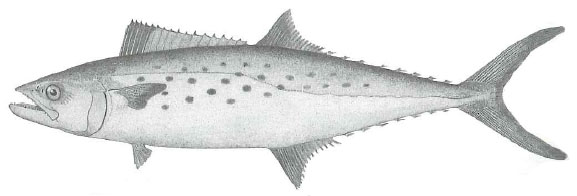
Information and species illustrations courtesy of the Food and Agriculture Organization of the United Nations (FAO).
SizeMaximum to at least 70 cm fork length, commonly to 50 cm. The IGFA all-tackle game fish record is 5.89 kg for a fish caught in North Carolina in 1987. |
Diagnostic characters Body elongate, strongly compressed. Snout much shorter than rest of head; posterior part of maxilla exposed, reaching to a vertical from hind margin of eye;many gill rakers on first arch (1 to 4, usually 2, on upper limb; 8 to 12, usually 10 or 11, on lower limb; 11 to 16, usually 12 to 14, total). Two scarcely separated dorsal fins, the first with 17 to 19 (usually 19) spines; dorsal and anal finlets 8 or 9; 2 flaps |
Habitat, biology, and fisheriesTends to form schools and enters tidal estuaries. Feeds on small fishes, especially sardines and anchovies. Caught mainly with purse seines and on line gear. Also an important sportfish taken by trolling feathers or pork rind or by casting fly and spinning lures into surface schools. Marketed mostly fresh or frozen; the flesh is highly appreciated. Landings recorded for S. maculatus in Area 31 between 1995 and 1999 ranged from 9,207 to 12,414 t per year. |
DistributionRestricted to the western North Atlantic (although reported from the eastern Pacific and eastern Atlantic, based on 2 other species, Scomberomorus sierra and Scomberomorus tritor, respectively). Ranges from Maine to Yucatán, primarily in waters over the continental shelf. Absent from Bermuda and most of the West Indies. Replaced from Belize to Brazil by a similar species, S. brasiliensis. |
CitationsCarpenter, K.E. (ed) Carpenter, K.E. (ed) Carpenter, K.E. (ed) |