

Southern stingray
Dasyatis americana
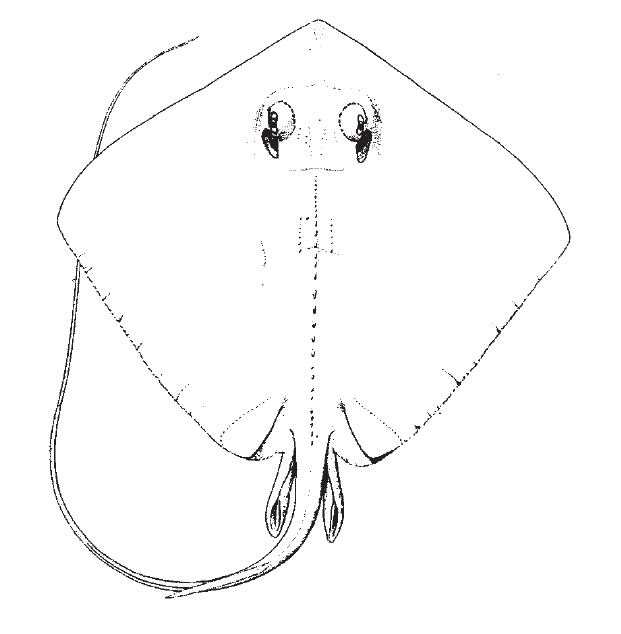
Information and species illustrations courtesy of the Food and Agriculture Organization of the United Nations (FAO).
SizeMaximum: 150 cm disc width; males mature at 51 cm disc width, females mature at 75 to 80 cm disc width, and young are 17 to 18 cm at birth. |
Diagnostic charactersDisc rhombic, about 1.2 times as broad as long; snout barely projecting; anterior angle of snout about 135 degrees ; outer and posterior corners of disc abruptly rounded or nearly acute-angled. Mouth arched; teeth arranged in 39 to 56 rows in the upper jaw. Teeth of females and juveniles with rounded cusps, those of mature males with sharp pointed cusps. Centre of floor of mouth with 3 stout papillae arranged in transverse series, sometimes single additional papilla on one or both sides. Tail slender and much longer than disc width; usually 1 (sometimes several or none) long, serrated, and poisonous spine(s) on base of tail; no dorsal fins or caudal fin; upper surface of tail with a low longitudinal ridge posterior to spine, lower surface with a longitudinal fin-fold originating at level of spine, depth of fold equal to height of tail above fold. Pelvic fins with a straight anterior margin and a rounded outer corner. A median row of irregularly (juveniles and half-grown individuals) or regularly (adults) spaced tubercles along midline from nuchal region to base of tail; a short longitudinal row of scapular tubercles on each side of midline; denticles in band along midline from between orbits to base of tail. Colour: dorsal surface light brown, grey, or olive, varying with substrate, with pale spot on midline of snout in front of eyes. Ventral surface white with grey or brown margins. Longitudinal ridge and fin-fold of tail dark brown. |
Habitat, biology, and fisheriesInhabits shallow waters, burying in sandy bottoms (more rarely, muddy bottoms). This species is an active swimmer, migrating in the summer months along the surface to the higher latitudes. It is found in water ranging from 15.4 to 30.3°C, generally at high salinities (28.5 to 36.2‰) but occasionally occurs in estuaries and fresh water. Feeds on bottom-dwelling invertebrates, mainly bivalves and worms; also on shrimps, crabs, and small ray-finned fishes. Litters range from 3 to 5. Caught mainly with trammel nets and bottom longlines; also with spears. Mainly east coast of the USA and Venezuela; to a lesser extent north coast of Colombia. Marketed salted; the flesh of the disc is well esteemed; remainder of body used in the preparation of gelatin and good quality oil. Very destructive to cockle and oyster farms; also dangerous to bathers and fishers because of the wounds it can inflict with its poisonous spine. |
DistributionWidely distributed from New Jersey to Florida, throughout the Gulf of Mexico, Bahamas, and the Greater and Lesser Antilles, and bordering the northern coast of South America to southeastern Brazil. |
CitationsCarpenter, K.E. (ed) Carpenter, K.E. (ed) Carpenter, K.E. (ed) |