

Smooth dogfish
Mustelus canis
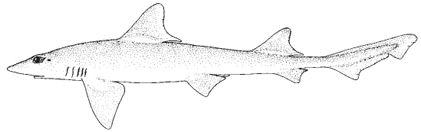
Information and species illustrations courtesy of the Food and Agriculture Organization of the United Nations (FAO).
SizeMaximum total length to 150 cm, common to 100 cm; size at birth between 34 and 39 cm; males maturing at about 82 cm, females at about 90 cm. |
Diagnostic characters A moderate-sized shark with an elongate and slender body, moderately flat on its ventral surface; a low sharp-edged dermal ridge on midline of back, particularly conspicuous between the 2 dorsal fins. Head flattened above and ending in a thin-tipped snout; snout moderately long, preoral length 5.5 to 8.0% of total length; 5 gill slits, the fourth above pectoral-fin origin; eyes moderately large, length 2.2 to 4.2% of total length; eyes with longitudinal external nictitating lower eyelids; spiracles small but prominent; space between nostrils broad, internarial width 2.7 to 3.6% total length; mouth relatively broad, width 4.7 to 6.8% of total length; labial furrows of upper jaw longer than those of lower jaw, length 1.6 to 2.7% of total length. Teeth small, ovate, low, arranged in several rows in a mosaic or pavement pattern, their cutting edges bluntly rounded. First dorsal fin higher than the second dorsal fin, base of first dorsal-fin anterior to pelvic-fin origins; both dorsal fins with rounded apices, deeply concave rear margins and acute rear corners; anal-fin origin about under midpoint of second dorsal-fin base; caudal fin rising only slightly above longitudinal axis of trunk, with a truncate tip and a well-marked subterminal notch, its ventral lobe small and rounded, but well defined; pectoral fins broad, Colour: back uniformly olive grey or slaty grey, the colour tone changing with the substrate; belly yellowish or whitish grey; posterior margin of first dorsal fin white in younger specimens. |
Habitat, biology, and fisheriesAn active bottom shark inhabiting coastal waters, especially on muddy bottoms; rarely down to 150 m; occasionally found in fresh water but not ascending rivers very far above their mouths. Migrates north and south with the seasons in the northern part of its range. Viviparous (placental viviparous), with 4 to 20 young per litter. Feeds mainly on crustaceans (crabs, lobsters, shrimps); also, on a variety of small demersal and pelagic bony fish, king crabs, squid, bivalves, gastropods, polychaete worms, and occasionally garbage. Kept in aquaria for public viewing. Fished in coastal waters, an important fisheries catch off Cuba, Mexico, and northeastern Venezuela, but probably caught wherever it occurs. Separate statistics are not reported for this species which is apparently abundant in some localities. Caught mainly with bottom longlines; also with floating longlines, probably gill nets, and occasionally with bottom trawls. Marketed fresh and salted, not highly esteemed as a food-fish in some places. |
DistributionWestern Atlantic; Canada south along the eastern coast of the USA to Florida and the Gulf Coast to Texas, Mexico, Bermuda, the Bahamas, Cuba, Jamaica, Puerto Rico and the Lesser Antilles to Venezuela, Suriname, French Guiana, Brazil, Uruguay, and Argentina; possibly absent from the Atlantic coast of Central America and northwestern South America. There are 2 allopatric subspecies, M. canis canis from continental waters from Canada to Argentina, and an insular form, M. canis insularis, from the islands of the Caribbean. |
CitationsCarpenter, K.E. (ed) Carpenter, K.E. (ed) Carpenter, K.E. (ed) |