

Silver perch
Bairdiella chrysoura
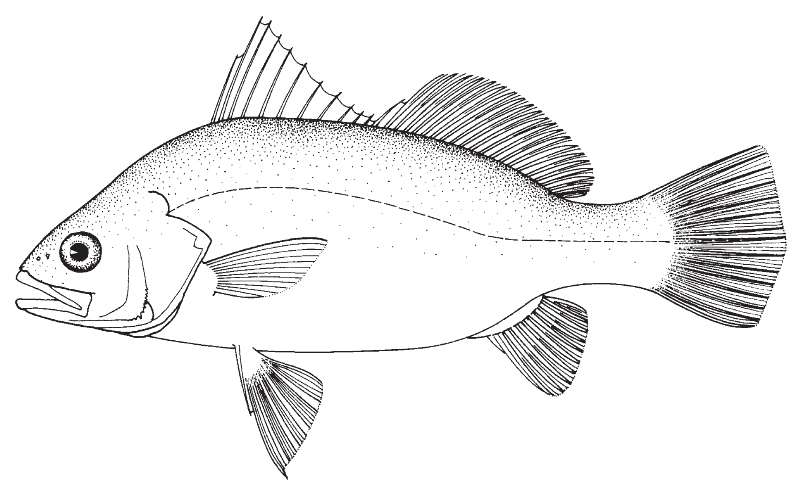
Information and species illustrations courtesy of the Food and Agriculture Organization of the United Nations (FAO).
SizeMaximum 25 cm; common to 20 cm. |
Diagnostic charactersA small fish, body oblong and compressed. Eye moderately large, about 4.5 in head length. Snout blunt; mouth terminal, moderately large and oblique; teeth small, set in narrow band on upper jaw and in a single row on lower jaw. Chin without barbel but with 6 mental pores (median pair often set in a pit); snout pointed with 8 pores (3 rostral and 5 marginal). Gill rakers long and slender, 22 to 24 on first arch. Preopercle with few spines at angle, lowest spine strongest and pointing downward. Spinous dorsal fin with 10 or 11 spines, posterior portion with 1 spine and 19 to 23 soft rays; anal fin with 2 spines and 8 to 10 soft rays, second spine sharp, more than 2/3 length of first soft ray; caudal fin truncate to slightly rhomboidal. Gas bladder with 2 chambers; anterior chamber yoke-shaped without appendages, posterior chamber simple, carrot-shaped. Lapillus enlarged, about 1/2 the size of sagitta. Scales ctenoid on body, head cycloid; basal halves of soft dorsal and anal fins covered with scales; lateral-line scales 45 to 50. Colour: silvery, greenish, or bluish above, bright silvery to yellowish on belly; lower fins mostly yellowish to dusky. |
Habitat, biology, and fisheriesFound in coastal waters over sandy and muddy bottoms, move to nursery and feeding areas in estuaries during summer months, sometimes enters fresh waters. Feeds mainly on crustaceans, worms, and occasionally fishes. No special fishery, caught mainly as bycatch with pound nets, seines, and bottom trawls, also by anglers. Only occasionally marketed fresh for human consumption (large specimens); mostly used for bait. |
DistributionAtlantic coast from Cape Cod to Florida and Caribbean islands; in Gulf of Mexico from west Florida to Rio Grande, Mexico. |
CitationsCarpenter, K.E. (ed) Carpenter, K.E. (ed) Carpenter, K.E. (ed) |