

Silver hake
Merluccius bilinearis
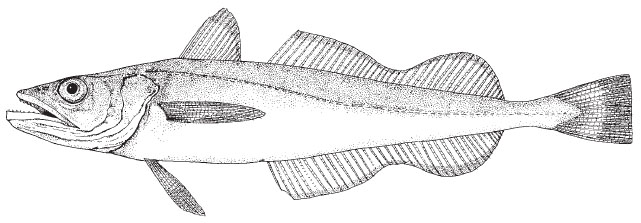
Information and species illustrations courtesy of the Food and Agriculture Organization of the United Nations (FAO).
SizeMaximum length about 76 cm. |
Diagnostic charactersHead length 24 to 27% of standard length; gill rakers long and pointed, 16 to 20 total on first arch. Second dorsal fin with 37 to 42 soft rays; anal fin with 37 to 42 soft rays. Scale rows 101 to 110 on lateral line. Total number of vertebrae 26 to 29. Colour: greyish dorsally, remaining areas silvery white. |
Habitat, biology, and fisheriesInhabits continental shelf depths from about 55 to 300 m, but also found in upper-slope waters to more than 900 m; occasionally strays into shallow coastal waters; seasonally migrates to shallower waters during warmer months, to deeper offshore waters in winter. Young of 1 to 3 years feed primarily on invertebrates (mostly crustaceans, especially euphausiids and pandalids); older fish feed mostly on fish and cephalopods; cannibalism significant and may regulate population of species. Spawning occurs in summer and early autumn and is highly dependent on water temperature. An important commercial fish in Area 21, but not found in significant quantities in Area 31. Marketed fresh, frozen, and smoked. |
DistributionAtlantic coast of North America from Florida to Newfoundland. |
CitationsCarpenter, K.E. (ed) Carpenter, K.E. (ed) Carpenter, K.E. (ed) |