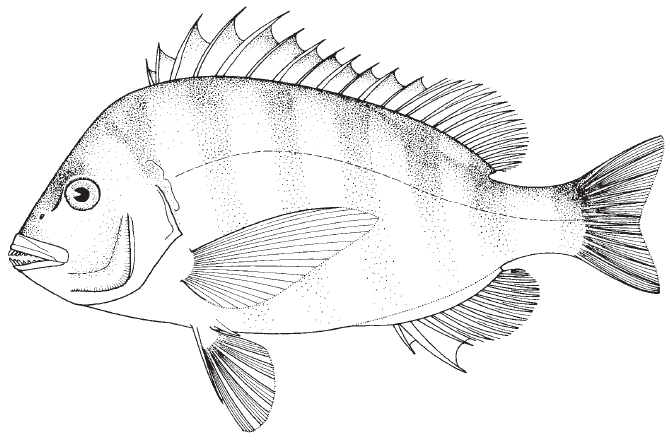
Information and species illustrations courtesy of the Food and Agriculture Organization of the United Nations (FAO).
Species Information
Size
Maximum to 91 cm, commonly to 35 cm; world game record 9.63 kg.
Diagnostic characters
Body oval, compressed and moderately deep (the depth about twice in standard length). Snout moderately blunt; posterior nostril slit-like; mouth comparatively small, the maxilla not reaching to below anterior eye margin. Jaws anteriorly with a series of 8 (4 on each side) broad incisor-like teeth, their edges straight or only slightly notched (in large adults); laterally with several series of molar-like teeth (3 in upper, 2 in lower jaw). Dorsal fin usually with 12 spines and 11 soft rays, preceded by a small forward-directed spine embedded in the skin. Anal fin with 3 spines, the second spine very strong; usually 10 anal-fin soft rays. Pectoral fins long, extending beyond the anal opening when appressed. Caudal fin slightly forked. Scales in lateral line 45 to 49. Colour: grey with 5 or 6 (rarely 4 or 7) dark vertical bars on body and one on nape, generally slightly narrower than pale interspaces (bars more evident on young); no dark spot near origin of lateral line.
Habitat, biology, and fisheries
Inhabits inshore, rocky, and hard-substrate areas; freely enters brackish water. Feeds primarily on sessile invertebrates such as bryozoans, molluscs, barnacles, and crustaceans. Caught mainly with bottom longlines and trawls; prominent in the catch of anglers. An excellent food fish; usually marketed fresh. The catch reported from Area 31 totaled 1 501 t in 2000.
Distribution
Nova Scotia to Florida and the Gulf of Mexico; absent from the West Indies; a few scattered reports from Honduras to Rio de Janeiro.