

Roughtail stingray
Dasyatis centroura
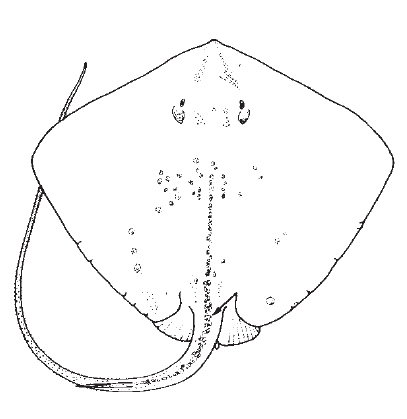
Information and species illustrations courtesy of the Food and Agriculture Organization of the United Nations (FAO).
SizeMaximum size 210 cm disc width (making it one of the largest known stingrays); males mature at 130 to 150 cm disc width (claspers of an 84 cm disc width male barely extending beyond tip of pelvic fins); females mature at 140 to 160 cm disc width, and neonates at 34 to 37 cm disc width at birth. |
Diagnostic charactersDorsal surface uniform dark brown to deep olive; ventral surface creamy white to yellowish. Dorsal surface with scattered enlarged tubercles and bucklers at about 30 cm disc width. |
Habitat, biology, and fisheriesFood consists of polychaetes, cephalopods, crustaceans, and ray-finned fishes. Litters range from 2 to 6 young. |
DistributionBenthic along the inner continental shelf to 91 m, rarely to 274 m. Recorded from Georges Bank and Cape Cod to southern Florida, northern and northeastern Gulf of Mexico, Bahamas, and coast of South America from southeastern Brazil to Argentina (also eastern Atlantic and Mediterranean Sea). |
CitationsCarpenter, K.E. (ed) Carpenter, K.E. (ed) Carpenter, K.E. (ed) |