

Northern puffer
Sphoeroides maculatus
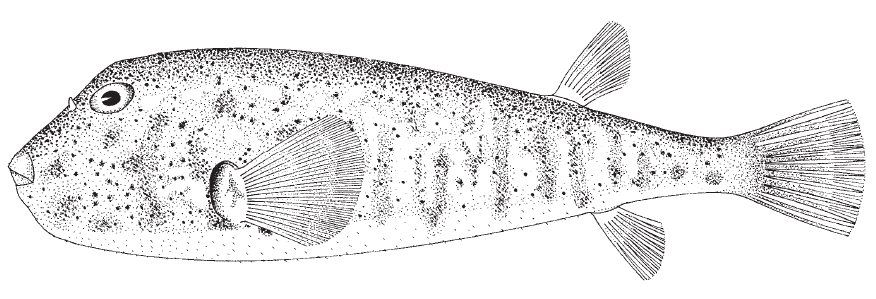
Information and species illustrations courtesy of the Food and Agriculture Organization of the United Nations (FAO).
SizeMaximum 250 mm; common to 200 mm. |
Diagnostic charactersA blunt-headed fish with heavy jaws forming a beak of 2 teeth in both upper and lower jaws. Dorsal and anal fins set far back near caudal fin; dorsal fin usually with 8 soft rays (no spines), anal fin with 7 soft rays (no spines); pectoral fins with 16 rays; pelvic fins absent. Body covered with prickles from around mouth region to dorsal and anal fins. No lappets on head or body. Colour: upper side grey or brown with poorly defined black spots and saddles; belly yellow to white; tiny jet-black pepper spots (about 1 mm in diameter) scattered over most of pigmented surface, particularly evident on cheeks; lower sides with a row of black, elongate, bar-like markings. |
Habitat, biology, and fisheriesFound in bays and estuaries, as well as offshore waters to depths of at least 60 m. Not a schooling species, but often occurring in large disorganized aggregations. Feeds primarily on shellfish, occasionally on finfish. The landings within the area, as reported by the USA, are negligible, but catches are higher further north; caught mainly with crab pots and on hook-and-line; marketed fresh as ‘Sea squab’; reportedly non-toxic, but often confused with toxic species. |
DistributionRestricted to the northern part of the area, off northeast Florida, northward extending to Newfoundland. |
CitationsCarpenter, K.E. (ed) Carpenter, K.E. (ed) Carpenter, K.E. (ed) |