

Monkfish
Lophius americanus
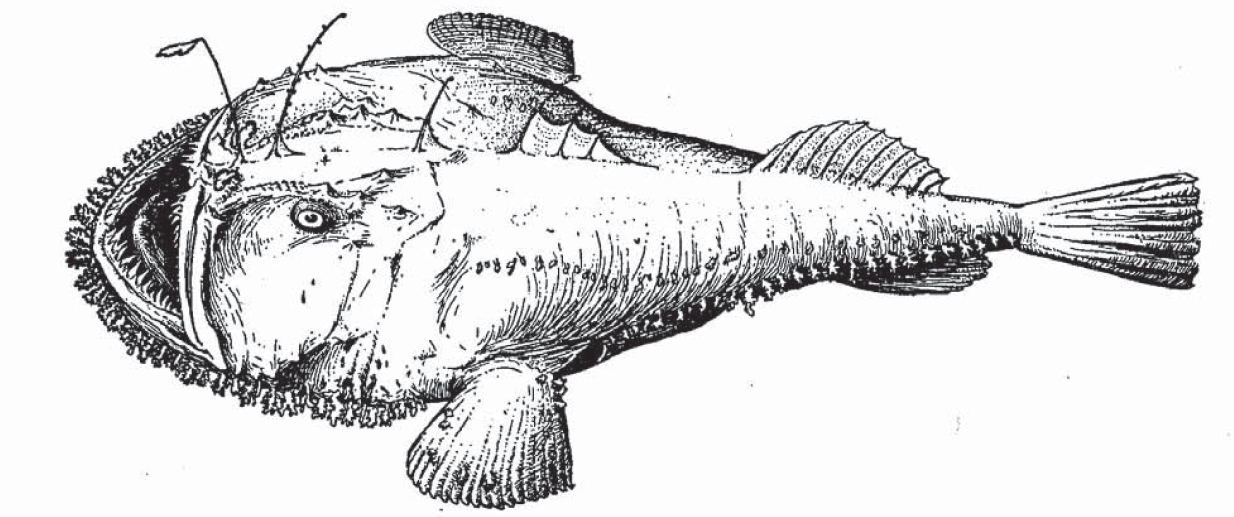
Information and species illustrations courtesy of the Food and Agriculture Organization of the United Nations (FAO).
SizeMaximum to 120 cm, commonly to 90 cm. |
Diagnostic charactersHead and anterior part of body much depressed and very broad, posterior portion of body tapering. Head appearing rounded from above, bearing numerous sharp spines on dorsal and lateral surfaces; humeral spines (in front of pectoral-fin bases) long, straight, well developed, with 2 smaller spines arising from sides; inner and outer sphenotic spines (behind eyes) well developed; frontal ridges (running forward from eyes) rough; gill openings below and behind pectoral-fin bases. First dorsal fin consisting of 3 isolated spines on head (cephalic spines), the foremost modified into an angling apparatus, and a group of short, slender spines behind head (postcephalic spines) connected by a black membrane; length of last (third) cephalic spine and of first (anteriormost) post-cephalic spine less than least distance between frontal ridges; second (soft) dorsal fin with 11 or 12 rays; pectoral fins with 25 to 28 rays; anal fin with 9 or 10 rays. Colour: dorsal surface uniformdark brown, ventral surface light tan; ventral surface of pectoral fins becoming abruptly darker distally. |
Habitat, biology, and fisheriesBottom-dwelling on both hard and soft substrates (hard sand, gravel, pebble, or shell bottoms to soft mud) from inshore waters (including high-salinity bays and estuaries when temperature is suitable) to continental slope at depths to at least 840 m; temperature range 0 to 24 degrees C (in Area 31, greatest winter concentrations at depths of 180 to 225 m (3 to 6 degrees C), greatest summer concentrations at 25 to 220 m, with the greatest abundance at 25 to 92 m (5 to 9 degrees C). Feeds mainly upon fishes, but known to take a variety of marine birds; attracts fishes by rapidly moving angling apparatus (illicium and esca); capable of swallowing very large prey; spawning from spring to early autumn; eggs contained within long (up to 12 m long by 1.5 m wide), ribbon-like, gelatinous mass called egg veil; a single female may produce over 1.3 million eggs. A good food fish, marketed fresh or frozen; present fishing grounds along the Atlantic coast of the USA, with main fishing grounds to the north of Area 31; caught mainly with trawls; separate statistics are not reported for this species from Area 31. |
DistributionCoast of eastern North America from the southern and eastern parts of the Grand Banks off Newfoundland, and the northern side of the Gulf of St. Lawrence southward to the coast of Florida (approximately 29 degrees N). |
CitationsCarpenter, K.E. (ed) Carpenter, K.E. (ed) Carpenter, K.E. (ed) |