

Little skate
Leucoraja erinacea
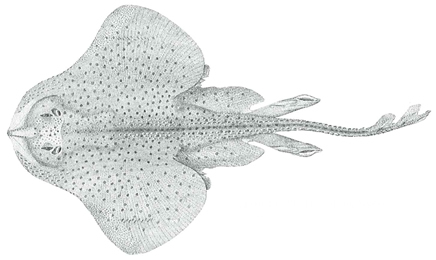
Information and species illustrations courtesy of the Food and Agriculture Organization of the United Nations (FAO).
SizeMaximum adult size 53 cm disk width (1.7 ft) |
Diagnostic charactersLateral most margins of disk more rounded than angular; snout more blunt than pointed; middorsal thorns absent in adults, except immediately posterior to interorbital region; dorsal surface of disk with small dusky spots; upper jaw with 70 or fewer series of teeth (typically 55 or fewer). Disk only slightly wider than long; dorsal fins equal in size and located near tip of tail; caudal fin represented by dermal fold extending over tip of tail; triangular patch of thorns present posterior to eye; 2 or 3 rows of thorns present on either side of dorsal midline and extending onto tail. Grayish to dusky brown dorsally; ventral grayish white. |
Habitat, biology, and fisheriesCommon in shallow waters along the coast, it has also been collected at depths greater than 150m. It feeds on bottom-dwelling organisms such as crabs, shrimps, polychaetes, sea squirts, mollusks, squids and bony fishes. Caught incidentally with bottom trawls and rod and reel. |
DistributionGulf of St. Lawrence to Cape Hatteras but most abundant from Georges Bank to Delaware Bay. |
CitationsCarpenter, K.E. (ed) Carpenter, K.E. (ed) Carpenter, K.E. (ed) |