

Kingfishes
Menticirrhus spp.
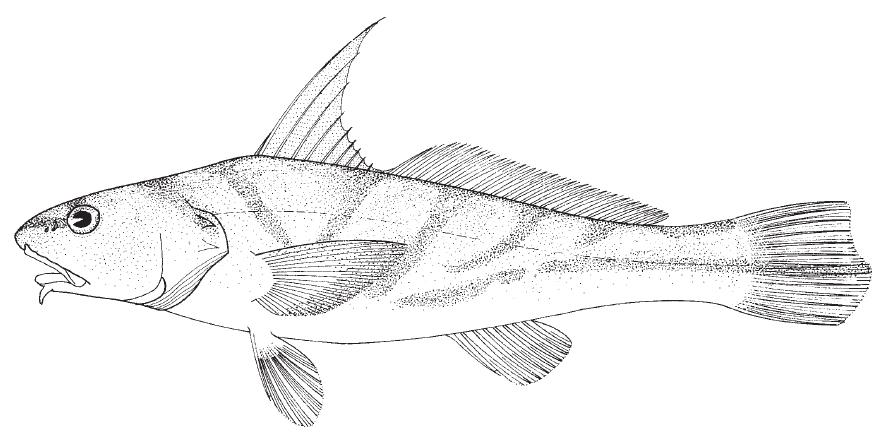
Information and species illustrations courtesy of the Food and Agriculture Organization of the United Nations (FAO).
SizeMaximum over 60 cm; common 30 to 35 cm. |
Diagnostic charactersSouthern kingfish (Menticirrhus americanus): A medium- to large-sized fish, distinctly elongate and rounded, with a broad, flat belly. Mouth small, inferior; maxilla reaching below hind margin of eye. Teeth villiform, set in broad bands on jaws, upper jaw with a distinctly larger, widely spaced outer row teeth. Chin with a single, short, and rigid barbel, perforated by a pore at tip and with 2 pairs of lateral pores; snout with 8 pores (3 rostral and 5 marginal); rostral fold (on lower margin of snout) deeply notched. Gill rakers short, knob-like, at most 10 (gradually disappearing with growth). Spinous dorsal fin with 10 spines (rarely 11), when pressed back, longest spine seldom extending beyond base of first soft ray, posterior portion with 1 spine and 22 to 26 soft rays; anal fin with 1 spine and 6 to 8 soft rays (usually 7); caudal fin S-shaped in adults. Gas bladder vestigial in adult. Sagitta oval elongate with thicker posterior half; lapillus rudimentary. Scales rather small, ctenoid on body and head, those on breast not distinctly reduced in size; soft dorsal fin naked except 1 row of small scales along its base. Colour: silvery grey, darker on back, belly white; overall darkness varying with habitat, often Northern kingfish (Menticirrhus saxatilis): A medium-sized fish, elongate, rounded with a flat belly, triangular in cross section. Mouth small, inferior; maxilla reaching below middle of eye. Teeth villiform, set in broad bands on jaws, outer-row teeth in upper jaw slightly enlarged, closely set. Chin with a single, short and rigid barbel, perforated by a pore at tip, and 2 pairs of lateral pores; snout with 8 pores (3 rostral and 5 marginal); rostral fold (on lower margin of snout) deeply notched.Gill rakers short, knob-like, 3 to 12, those on lower limb of gill arch gradually disappearing with growth. Spinous dorsal fin with 10 spines (rarely 11); longest spine always extending well beyond base of seventh or eighth soft ray when depressed; posterior portion with 1 spine and 22 to 27 soft rays; anal fin with 1 spine and 7 to 9 (usually 8) soft rays; caudal fin S-shaped in adults.Gas bladder vestigial in adults,but moderately developed in young (to 11 cm total length). Sagitta oval elongated and thin; lapillus rudimentary. Scales moderately small, all ctenoid, those on breast not distinctly reduced in size; soft dorsal fin naked except 1 rowof small scales along its base.Colour: silvery grey, darkish on back and whitish on belly; sides always with 5 or 6 conspicuous oblique bars, the second and third bars form a V-shape marking under spinous dorsal fin; a dark longitudinal stripe present behind pectoral fin; spinous portion of dorsal fin dark at tip with black margin; pectoral, pelvic and anal fins dusky and often with black tip. Inner side of gill cover dusky. |
Habitat, biology, and fisheriesFound in shallow coastal waters over sand to sandy mud bottoms; rather common in the surf zone and in estuaries; juveniles may enter tidal rivers and creeks of low salinity (less than 1‰). Feeds on bottom-dwelling organisms, mainly worms and crustaceans. Caught mainly with bottom trawls, pound nets, and seines; also by anglers. No special fishery, but caught along with other Menticirrhus species; important fishing grounds are located to the north of the area. Marketed mostly fresh, an excellent foodfish. |
DistributionGulf of Maine to northern Argentina, common from Chesapeake Bay to Florida, and in Gulf of Mexico from Cape Sable, Florida to Bay of Campeche, Mexico, Caribbean coast to southern Brazil, not common in Venezuela, few records from the greater Antilles, none from the lesser Antilles. |
CitationsCarpenter, K.E. (ed) Carpenter, K.E. (ed) Carpenter, K.E. (ed) |