

Inshore lizardfish
Synodus foetens
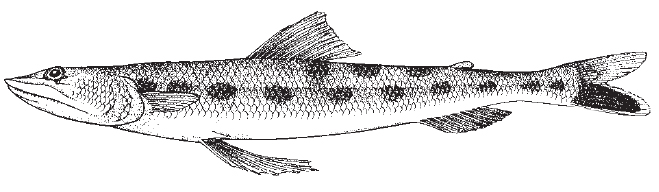
Information and species illustrations courtesy of the Food and Agriculture Organization of the United Nations (FAO).
SizeMaximum size to about 40 cm; commonly to about 30 cm; world game record 0.9 kg. |
Diagnostic characters Small to medium-sized (to 45 cm) fish with elongate cylindrical body. Head depressed; bony surfaces on top of head, snout triangular and sharply pointed, its length greater than diameter of eye; length of anal-fin base about equal to or usually longer than dorsal-fin base (rarely shorter); tip of pectoral fin falling short of or just reaching of pelvic-fin base; predorsal scales 20 to 30. Eye of moderate size; laterally directed. Adipose eyelid on anterior and posterior margins of eye. Mouth large, gape tending to be oblique. Upper jaw not protractile, its entire length bordered by premaxillary, its length more than half length of head and extending well past posterior margin of orbit in adult specimens; maxilla absent. Teeth of moderate size, depressible; no distinct canines; teeth on palatines, present in a single band and on tongue. Vomer absent. Gill openings large; gill membranes free from isthmus; 4 gill arches, extending far forward into mouth, well in advance of the angle of gape. Opercular flap with free edge formed by both opercle and subopercle. Gill rakers rudimentary or minute and spine-like. Branchiostegals 15 to 18. Head and body with cycloid scales. Fins with articulated soft rays except a few anterior secondary |
Habitat, biology, and fisheriesInhabits shallow inshore waters in salt-water creeks, rivers, bays, and sounds and along open beaches on mud or sand bottoms; also ranges out over the continental shelf to depths of 180 m. A voracious predator that buries itself in the sand or mud to ambush prey; feeds mainly on fishes and small mobile invertebrates. Apparently a seasonal migrant in the northern part of its range. Of little importance to fisheries; taken incidentally in shrimp trawls and seldom marketed. |
DistributionWidely distributed along the Atlantic coast of the American continents from the vicinity of Cape Cod to Brazil, including Bermuda and the Caribbean Sea. |
CitationsCarpenter, K.E. (ed) Carpenter, K.E. (ed) Carpenter, K.E. (ed) |