

Hickory shad
Alosa mediocris
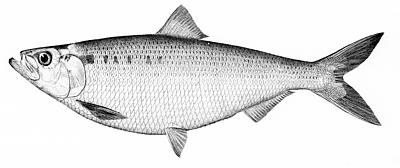
Information and species illustrations courtesy of the Food and Agriculture Organization of the United Nations (FAO).
SizeMaximum size to 60 cm standard length, commonly to 40 cm standard length. |
Diagnostic charactersBody depth greater than head length. Small, mostly silvery, with fusiform, subcylindrical bodies; with a complete series of scutes present along abdomen; pelvic scute with lateral arms; series of abdominal scutes present, keeled. Terminal mouth; upper jaw with deep median notch; lower jaw not rising steeply within mouth; jaw teeth present; gill rakers on lower limb of anterior arch less than 25; lower jaw projecting beyond upper when mouth closed; 2 supramaxillae. Eyelids with vertical opening in middle. Fins lacking spiny rays; a single dorsal fin, usually short and at midpoint of body; pectoral fins set low on body; pelvic fins about equidistant between pectoral-fin base and anal-fin origin; anal fin often short (usually less than 30 rays); caudal fin always deeply forked. Last dorsal-fin ray not filamentous. Scales cycloid (smooth to touch), but often shed easily; no lateral line. Scales without posterior striations. Predorsal scales along dorsal midline normal; other scales with smooth posterior margins; 8 branched pelvic-fin rays. Colour: typically dark blue or blue-green on dorsum and silvery on sides; with variable darker markings including dark shoulder spot. |
Habitat, biology, and fisheriesCoastal and tidal fresh waters; euryhaline, entering brackish and fresh water, anadromous. Most of adult life spent in sea. Spawns in tidal fresh water (Patuxent River, Chesapeake Bay in May-June; Virginia rivers and southern part of range in February- May). Sexually mature at 3 to 5 years. Estimated fecundity 43,000 to 348,000 eggs/female.Feeds on small fishes, also squids, small crabs, and other crustaceans, as well as fish eggs. Of minor importance to fisheries. Caught with seines, pound nets, and in lesser quantities in gill and fyke nets. |
DistributionWestern North Atlantic (Maine southward to the St. Johns River, Florida); also in rivers. |
CitationsCarpenter, K.E. (ed) Carpenter, K.E. (ed) Carpenter, K.E. (ed) |