

Harvestfish
Peprilus paru
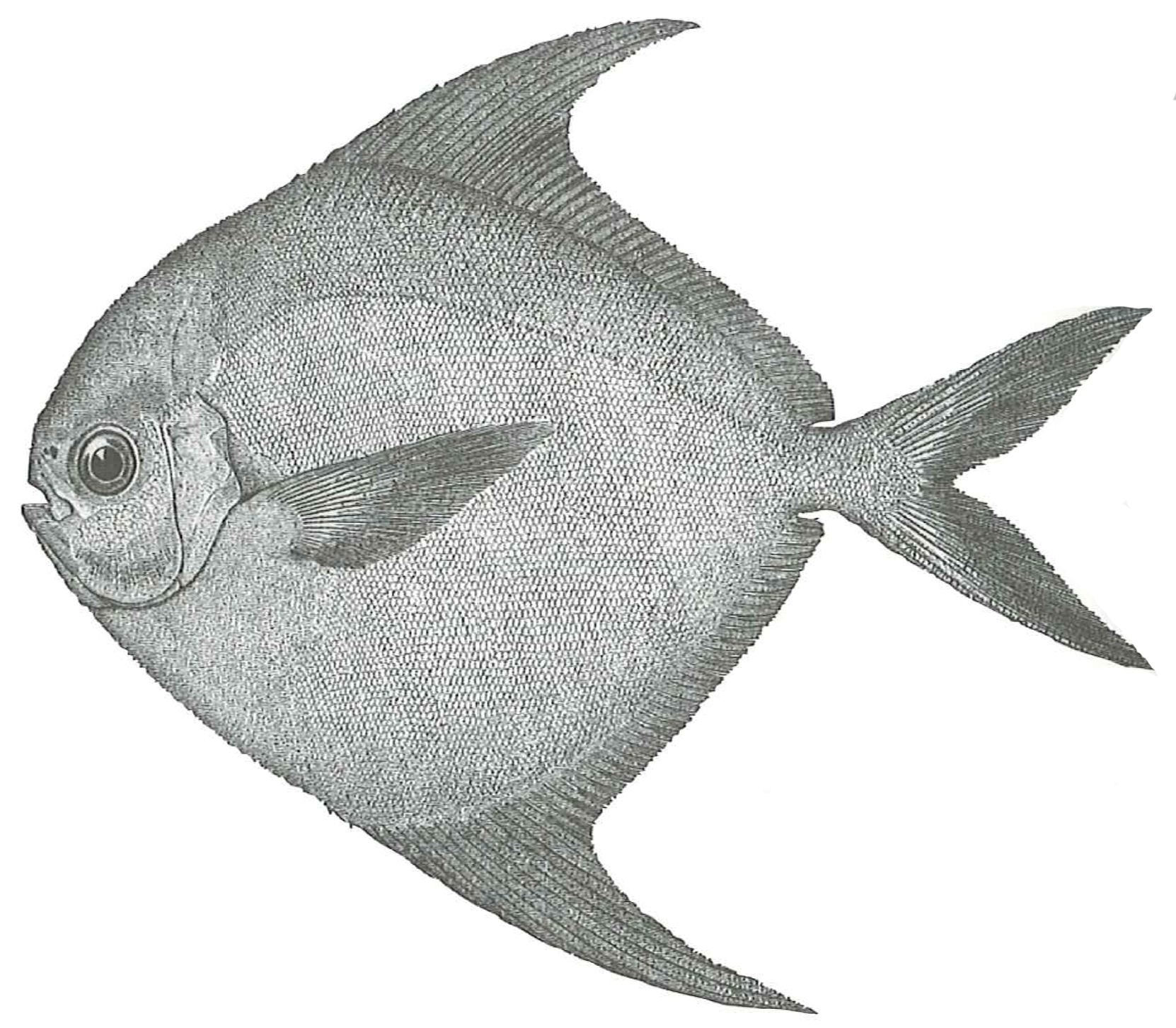
Information and species illustrations courtesy of the Food and Agriculture Organization of the United Nations (FAO).
SizeMaximum to 30 cm, commonly to 18 cm. |
Diagnostic charactersBody very deep (its depth 1.6 to 1.8 in total length), bounded by even curves and strongly compressed. Snout short and blunt, about equal to eye diameter. Mouth small, tip of maxillary just reaching to below eye margin; teeth in jaws weak, in 1 row, those in the upper jaw slightly recurved, simple and pointed. Dorsal and anal fin bases very long (about equal in length), both fins falcate, the length of their longest rays greater than head and preceeded by 3 weak spines; caudal fin stiff and deeply forked, both its lobes longer than head; pectoral fins narrow and much longer than head; pelvic fins absent. No conspicuous series of pores below dorsal fin; lateral line high, following dorsal profile; scales small and easily detached, extending to cheeks and bases of vertical fins. Colour: pale blue to green above, silvery with a golden/yellow tinge below. |
Habitat, biology, and fisheriesA pelagic fish forming large schools in coastal bays, inshore waters over the continental shelf and around islands at moderate depths (50 to 70 m) where it occurs throughout the year; juveniles found in shallow coastal waters under floating weeds or in association with medusae. Adults feed mainly on jellyfish and small fish, crustaceans and worms; the juveniles are plankton feeders. Caught mainly with otter trawls, also seines; marketed fresh and frozen, exported to Japan where it has been well received. Fishing in the area occurs mainly in inshore waters off eastern Florida, the northeastern part of the Gulf, western Venezuela and the Guianas; also may be fished occasionally on the Campeche Bank. Prior to about 1990, except for a short period in the early 1960s, only negligible amounts of harvestfish were landed. Venezuela has developed its fishery since then, and currently (1996) is landing about 2,000 t annually. Cumulative landings until 2024 total 26,738 t. |
DistributionFlorida, Gulf of Mexico, coasts of Venezuela, Trinidad and the Antilles: infrequent in the western Caribbean, and absent from Bermuda and Bahamas. Along the Atlantic coasts of America it extends from about Chesapeake Bay (straying rarely to the Gulf of Maine) south to warm continental shelf waters of Argentina. |
CitationsCarpenter, K.E. (ed) Carpenter, K.E. (ed) Carpenter, K.E. (ed) |