
Gulf stream flounder

Citharichthyes arctifrons
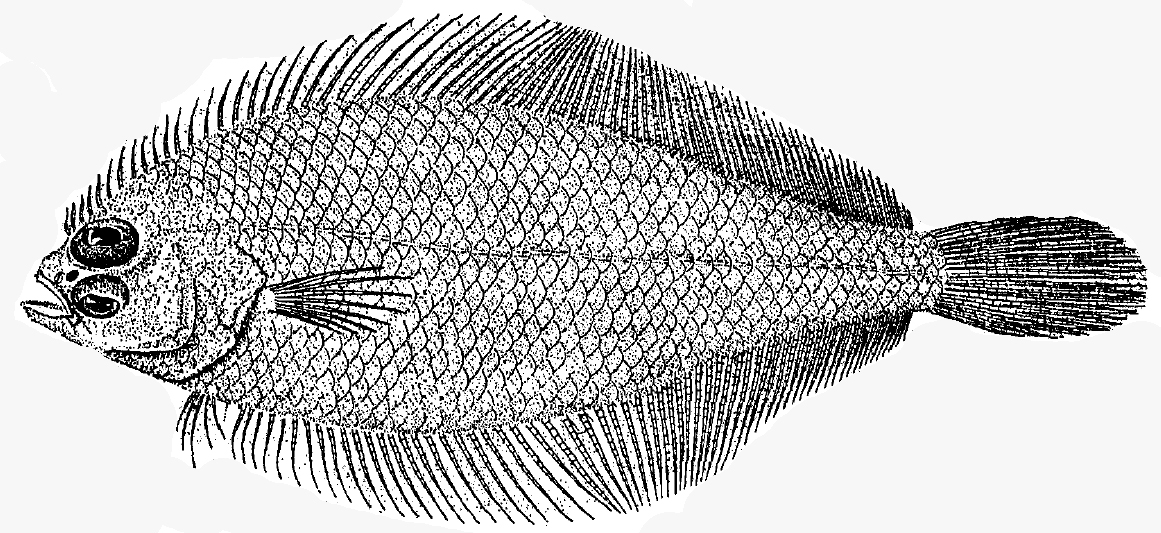
gulf_stream_flounder1.jpg


Information and species illustrations courtesy of the Food and Agriculture Organization of the United Nations (FAO).

Species Information

Size

Maximum size to 18 cm.

Diagnostic characters

 Eyes on left side of head.  No spines present in fins. Mouth protractile, asymmetrical, lower jaw moderately prominent. No teeth on vomer. Preopercle exposed, its posterior margin free and visible, not hidden by skin or scales. Urinary papilla on blind side, not attached to first anal-fin ray. Dorsal fin long, originating above, lateral to, or anterior to upper eye. Dorsal and anal fins not attached to caudal fin. Both pectoral fins present. Both pelvic fins present, with 5 or 6 rays (6 rays in nearly all species); base of pelvic fin of ocular side on midventral line. Caudal fin with 17 or 18 rays, 10 to 13
rays branched (usually 11 or 13, rarely 10 or 12). Lateral line present and obvious on both sides of body; lateral line without high arch over pectoral fin; lateral line absent below lower eye. 
Colour: ocular side uniformly brownish or greyish, often with spots, blotches, or ocelli; blind side usually pale; although ambicoloration (eyed-side coloration replicated on blind side) may occasionally occur.

Mouth large, maxilla less than 3.5 in head length usually reaching posteriorly to vertical
through mideye; jaws on blind side not arched; front teeth in jaws enlarged, larger
than lateral teeth

Both jaws with a single row of fixed (immovable) teeth

Scales ctenoid; gill rakers slender and moderately long

Osseous protuberance on snout; upper-jaw length less than 33% head length (31% head
length in some specimens of C. spilopterus); body depth 34 to 43% standard length (usually
less than 40%).

Habitat, biology, and fisheries

Occurring at depths of 40 to 370 m; occasionally at shallower depths (20 m). Visually orienting ambush predator; feeds predominately on polychaetes and crustaceans, primarily amphipods.

Distribution

Continental shelf off the Atlantic coast of the USA (Massachusetts to Florida), and Gulf of Mexico (Florida to Yucatán, Mexico).

Citations

Carpenter, K.E. (ed)
The living marine resources of the Western Central Atlantic. Volume 1: Introduction, molluscs, crustaceans, hagfishes, sharks, batoid fishes, and chimaeras.
FAO Species Identification Guide for Fishery Purposes and American Society of Ichthyologists and Herpetologists Special Publication No. 5.
Rome, FAO. 2002. pp. 1-600.

Carpenter, K.E. (ed)
The living marine resources of the Western Central Atlantic. Volume 2: Bony fishes part 1 (Acipenseridae to Grammatidae).
FAO Species Identification Guide for Fishery Purposes and American Society of Ichthyologists and Herpetologists Special Publication No. 5.
Rome, FAO. 2002. pp. 601-1374.

Carpenter, K.E. (ed)
The living marine resources of the Western Central Atlantic. Volume 3: Bony fishes part 2 (Opistognathidae to Molidae), sea turtles and marine mammals.
FAO Species Identification Guide for Fishery Purposes and American Society of Ichthyologists and Herpetologists Special Publication No. 5.
Rome, FAO. 2002. pp. 1375-2127.